The Story Behind
A Rare One-Acre Estate Commanding the Bird Streets Skyline
There are properties defined by their scale, and there are those defined by their intention. The estate at 8741 Saint Ives Drive belongs firmly to the latter. Conceived by NOBEL Design and Architecture Studio — a practice recognized for its rigorous attention to material, proportion, and experiential sequence — the residence unfolds across approximately 14,000 square feet with the measured confidence of architecture that has nothing to prove and everything to reveal.
Entry is its own moment. A monumental pivot door opens into a foyer where reclaimed wood ceilings meet dark stone flooring, establishing a material language that will repeat and evolve throughout the home. The double-height living room that follows is anchored by a fireplace wrapped in ribbed travertine with custom iron detailing — a gesture that is simultaneously structural and sculptural. Walls of glass dissolve the threshold between interior volume and open sky, allowing light to move fluidly through the day, casting intentional shadow across every surface as the hours shift.
The open floor plan maintains a continuous dialogue between spaces without sacrificing distinction. A more intimate lounge and bespoke bar area offer counterpoint to the grand living room's volume, while the dining area and custom chef's kitchen — outfitted with a travertine center island beneath reclaimed wood overhead — function as both working environment and visual focal point. The kitchen is positioned to overlook the living and dining rooms, preserving a sense of connection to the heart of the home without compromising its own sense of craft.
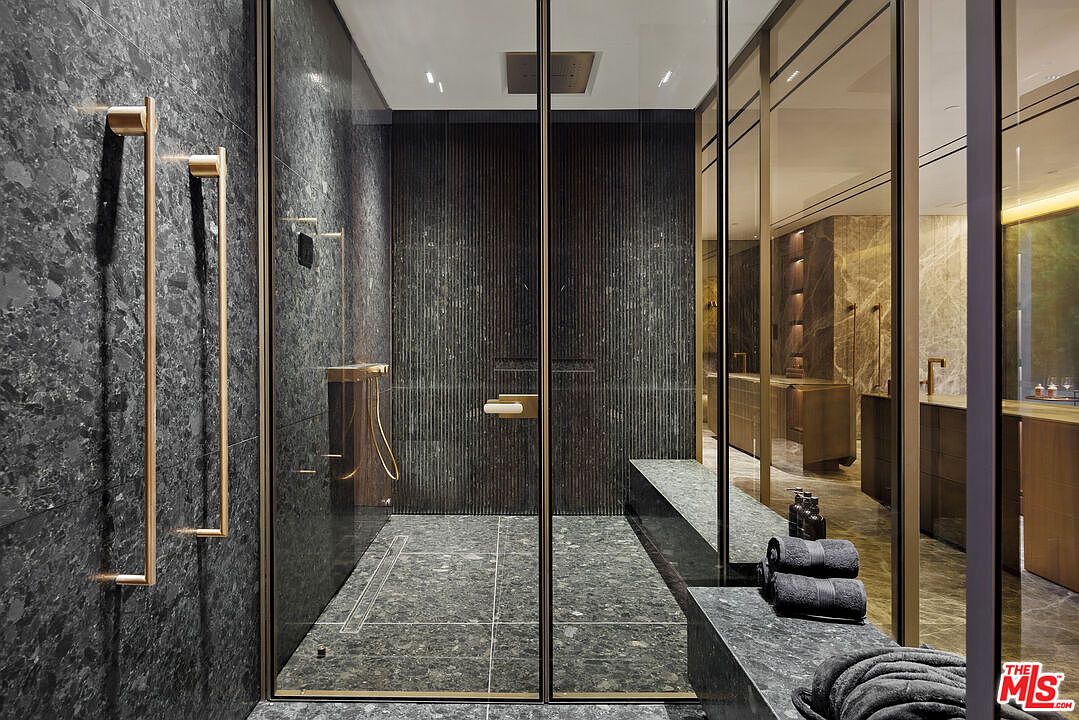
The primary suite is defined by generous volume and quiet privacy. Floor-to-ceiling glass frames the skyline from the bedroom itself, while the bath is finished in grey marble with bronze fixtures, a stone soaking tub, and an oversized shower clad in dark stone tiling. The walk-in wardrobe features mirrored wall panels and integrated LED display cabinetry — organized, considered, and quietly extraordinary. Each of the four additional bedrooms is proportioned for comfort and appointed with its own en-suite bath.
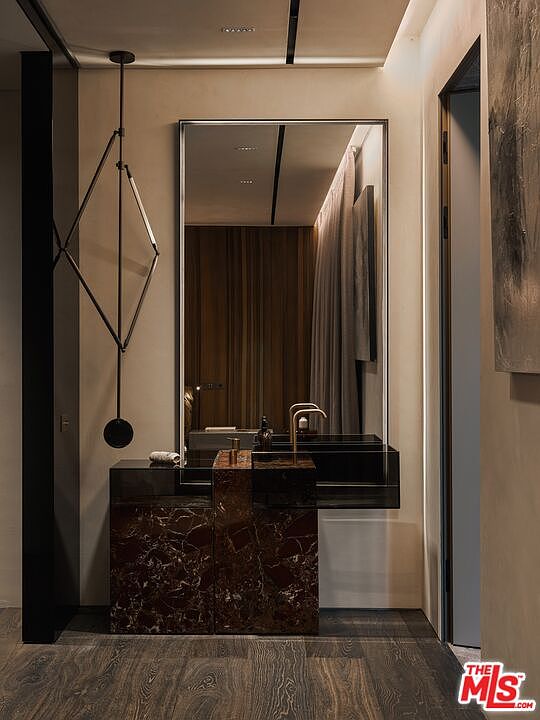
Wellness and leisure receive equal architectural attention. A dedicated spa and salon area is finished in richly toned burgundy marble — a bold material choice that reads as both grounding and indulgent. The home theater, designed with sunken modular seating upholstered in burnt-orange velvet and acoustic-paneled walls, carries a deliberate nod to the cinematic atmosphere of 1970s design, reimagined through a contemporary lens.
Outdoors, a long linear infinity-edge pool with an integrated fire feature extends toward the horizon above broad, level lawns — rare usable ground at this elevation. Covered patio terraces, mature landscaping, and sweeping city views complete an outdoor environment as intentional as the spaces within. Privately gated with parking for up to ten vehicles, the estate offers a level of seclusion that belies its proximity to the pulse of the city below.
The Bird Streets occupy a narrow band of elevated terrain above the Sunset Strip in West Hollywood, and within Los Angeles real estate, they represent something genuinely singular. Named for the avian-themed roads that wind through the hillside — Oriole, Thrush, Nightingale, Robin, and their neighbors — the neighborhood sits at an elevation that affords sweeping, unobstructed views of the Los Angeles Basin while remaining only minutes from the city's most storied commercial corridor.
The area's character was shaped in part by the mid-century architectural experimentation that defined much of the Hollywood Hills during the postwar decades. As Los Angeles emerged as a global cultural capital, the hillsides above Sunset attracted architects, artists, and entertainment figures drawn to the combination of privacy, elevation, and proximity to the creative industries concentrated below. That legacy of design ambition persists today, and the Bird Streets have become one of the most sought-after addresses in the city for buyers who understand that a home's location is as much about cultural context as it is about geography.
The Sunset Strip itself — Sunset Boulevard between Doheny Drive and Crescent Heights Boulevard — runs along the base of the neighborhood and remains one of Los Angeles's most recognized and energetic stretches of urban life. The corridor is home to celebrated dining destinations, boutique hotels including the Mondrian and the Sunset Tower Hotel, live music venues with deep roots in the city's rock and entertainment history, and some of the most prominent creative agency offices in the industry. The energy is specific to Los Angeles: ambient, unhurried, and quietly influential.
To the east, West Hollywood's Santa Monica Boulevard and Robertson Boulevard corridors offer a dense concentration of design showrooms, galleries, and culinary destinations that have long made the neighborhood a reference point for taste. The Pacific Design Center — a landmark complex of interconnected exhibition and showroom buildings designed by Cesar Pelli — anchors the neighborhood's identity as a center of design culture and serves as a literal reference point in the views from the estate itself.
Beverly Hills lies immediately to the west, placing Rodeo Drive, the Beverly Hills Hotel, and the retail and dining resources of Canon Drive within a short drive. Cedars-Sinai Medical Center, one of the most recognized medical institutions in the country, is similarly proximate — a practical consideration for families and full-time residents.
What the Bird Streets offer, beyond access, is a particular quality of remove. At this elevation, the ambient noise of the city recedes. The view — stretching from the Pacific Design Center across the West Hollywood basin to the towers of Downtown Los Angeles — functions as a kind of living panorama, shifting with the light and the hour. It is a vantage point that makes the city legible in a way that ground-level residence cannot. For those who have chosen to live here, the address is less about convenience than it is about perspective — a word that applies equally to the views and to the sensibility that defines life above the Strip.
Featured Highlights
Curated Content • Presented by Alexis Perry