The Story Behind
Hamptons-Style Estate on a Sunny, Private 29,000-SF Clyde Hill Lot
From the moment the iron gate swings open and the circular drive comes into view, it is clear that this estate was conceived at a different order of magnitude than the homes surrounding it. Gray shingle siding, steeply pitched gables, and a broad arched entry speak the formal language of Hamptons architecture — a vocabulary rooted in late nineteenth-century Shingle Style that prizes asymmetry, natural materials, and the graceful layering of interior and exterior space. Here, that tradition has been reinterpreted with the precision and amenity expected of a twenty-first-century luxury residence.
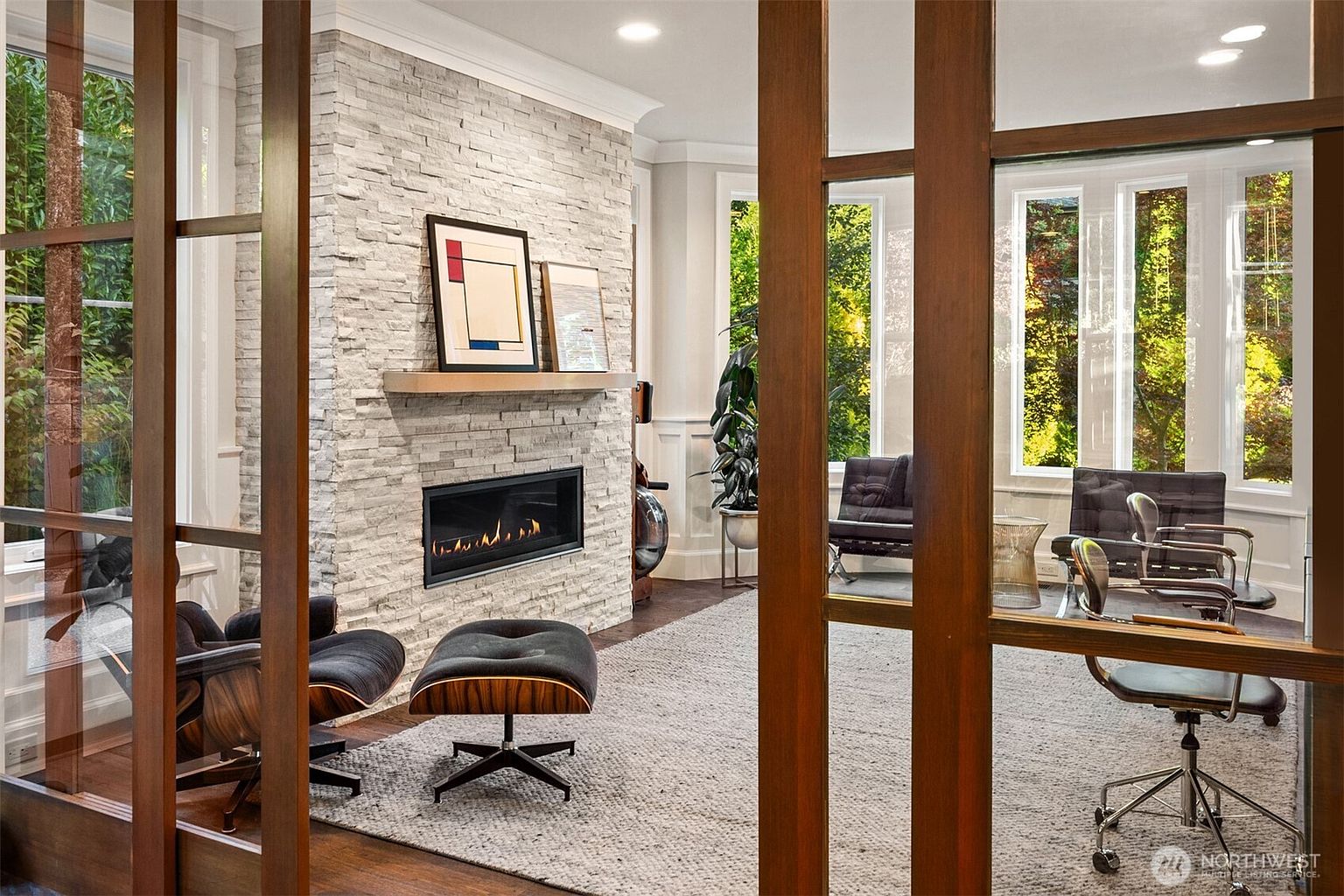
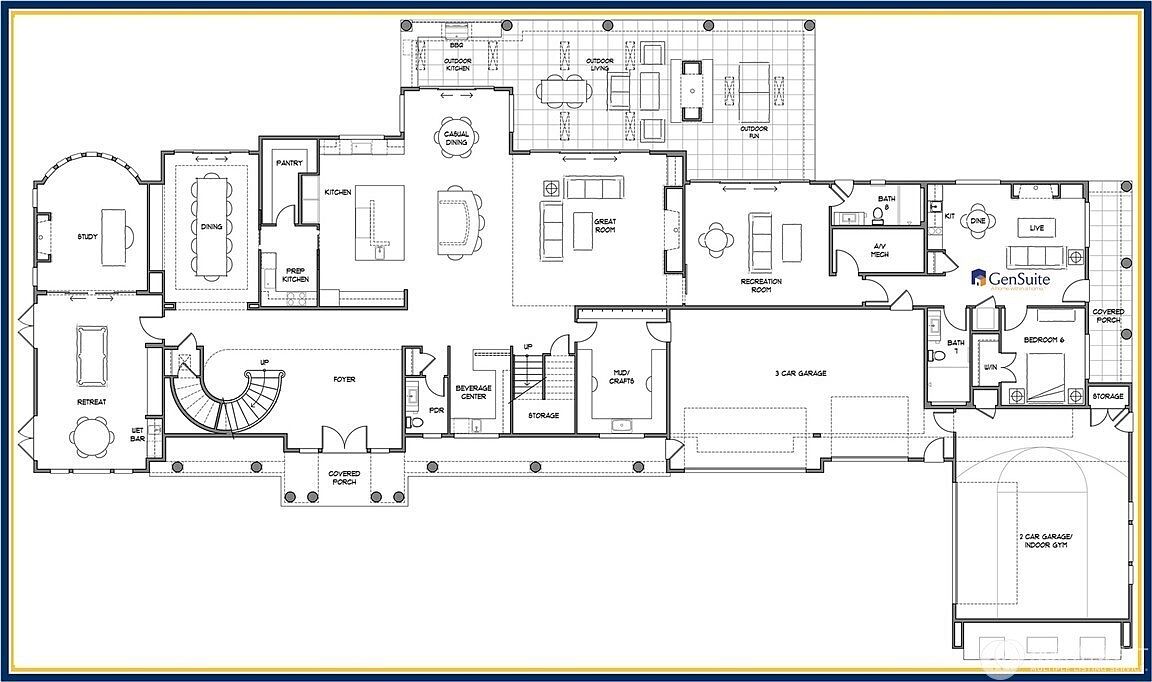
The foyer announces the home's intentions immediately. A sweeping curved staircase — white railings, dark wood treads, a soaring multi-tiered chandelier overhead — rises through a volume finished in white shiplap and dark hardwood, establishing the palette of contrast that carries throughout. The great room beyond is generous without being cavernous, organized around a stacked-stone fireplace that ascends to the full ceiling height and opens visually through tall glass sliding doors to the covered outdoor room behind.
The chef's kitchen is a professional-grade environment by any measure. Dual stone-countertop islands — one stretching a full twelve feet — provide staging, preparation, and casual dining surfaces simultaneously. A professional-grade range anchors the cooking wall beneath a substantial stainless steel vent hood, and glass pendant lights suspended above the islands add warmth to a space that might otherwise read as purely utilitarian. A separate prep kitchen ensures that the main kitchen can remain presentation-ready even during serious entertaining.
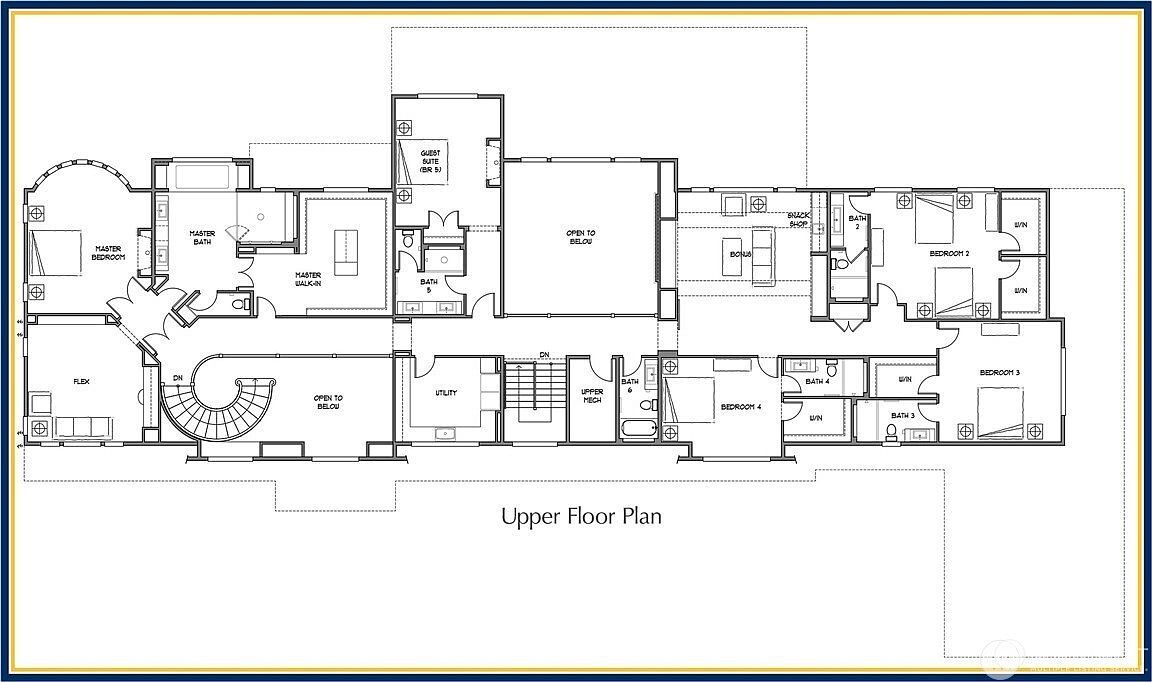
Six bedroom suites are distributed thoughtfully across the upper floor, each with its own bath. The primary suite is a destination in itself: a bay window curves into the morning light, a fireplace provides ambient warmth, and the spa bath — soaking tub, stone countertops, glass-enclosed shower, dedicated vanity — achieves the caliber of a high-end hotel without any of the impersonality. A private-entry GenSuite, complete with its own kitchen, living area, bedroom, and bath, offers genuine autonomy for extended family, guests, or household staff.
The covered outdoor living room may be the estate's most quietly remarkable feature. Stone-clad fireplace, integrated ceiling heaters, mounted television, and a full outdoor kitchen with a built-in grill transform what might otherwise be a seasonal amenity into a year-round room — one that overlooks manicured lawns framed by tall privacy hedges and mature plantings that effectively disappear the outside world.
And then there is the indoor basketball court — a full-size recreational space with painted court markings and a regulation hoop, housed within the estate's footprint and served by natural light from generous windows. It is the kind of amenity that appears on wish lists and almost never on closing documents, a detail that underscores the completeness of a home designed not merely to impress but to be genuinely, fully lived in. Five garage bays and additional surface parking for six to eight vehicles ensure that the estate's hospitality extends without friction from the front gate to every corner of the property.
Clyde Hill occupies a modest but commanding elevation on the eastern shore of Lake Washington, a small incorporated city of roughly three thousand residents that has maintained its residential character with remarkable consistency since its incorporation in 1953. The city encompasses approximately one square mile, and that deliberate constraint is part of its appeal: there is no commercial corridor to speak of, no through-traffic congestion, no high-density development pressing against the property lines. Clyde Hill exists, by design and by code, as a place where large lots, mature trees, and single-family residences constitute the entire civic fabric.
The topography rewards its residents. Homes on the hill's upper reaches capture views of Lake Washington, the Seattle skyline, and on clear days the Olympic Mountains beyond. The orientation toward the southwest means that lots like this one — level, open, and unobstructed — collect afternoon sun with unusual generosity for a region more often associated with overcast skies. The combination of elevation, exposure, and the thermal moderating influence of the lake gives Clyde Hill a microclimate that residents consistently cite as one of the neighborhood's understated advantages.
The surrounding Eastside context amplifies the location's value considerably. Downtown Bellevue, one of the Pacific Northwest's most dynamic urban centers, lies minutes to the south. The Bellevue Collection — anchored by Bellevue Square and encompassing Lincoln Square and Bellevue Place — represents one of the most successful retail environments in the region, with luxury brands, independent restaurants, and a performing arts center clustered within easy reach. The Bellevue Arts Museum and the annual Bellevue Arts Museum ArtsFair contribute a cultural dimension that has grown steadily as the city has matured.
For families, the property falls within the Bellevue School District, consistently ranked among the highest-performing public school systems in Washington State and recognized nationally for academic outcomes and program breadth. Private school options, including the Overlake School and Bellevue Christian School, are similarly close at hand.
Outdoor recreation is woven into the fabric of daily life here in ways that distinguish the Pacific Northwest from virtually every other luxury market in the country. Chism Beach Park, a beloved Lake Washington access point with swimming areas, tennis courts, and picnic grounds, is minutes away. The Burke-Gilman and Sammamish River trails connect to an extensive regional network suitable for cycling, running, and walking. Mercer Slough Nature Park, one of the largest remaining wetlands on the Eastside, offers kayaking and nature trails within the urban fabric of Bellevue itself.
Connectivity to Seattle is straightforward via the SR-520 floating bridge, placing the cultural and commercial resources of a major metropolitan city within a commute that rarely exceeds twenty minutes under normal conditions. The proximity to major technology employers — Microsoft's Redmond campus, Amazon's growing Bellevue presence, and a dense constellation of technology companies across the Eastside — has reinforced demand in Clyde Hill for decades and continues to do so. In a region where land is finite and character neighborhoods are genuinely rare, an address on Clyde Hill represents not merely a home but a considered and lasting position.
Featured Highlights
Curated Content • Presented by Chris Koehler