The Story Behind
777 Feet of Saratoga Passage Waterfront on Twenty Private Acres
There are properties defined by their views, and then there are properties defined by everything at once — the architecture, the land, the water, the light, and the unmistakable sense that something rare and enduring has been assembled here. The estate at 1035 Susan Street is emphatically the latter.
The main residence announces itself with clean, white horizontal siding, a multi-gabled roofline, and a covered timber-framed entry that sets the tone for what lies within: single-level living conceived with genuine intention. Inside, vaulted ceilings rise above warm wood flooring, and the living space organizes itself around a commanding stone-surround fireplace that anchors the room without overwhelming it. Multiple sets of glass doors open in concert to a central courtyard — a design decision that transforms the home's relationship with the landscape, pulling sea-to-island views into nearly every room and dissolving the boundary between interior comfort and Pacific Northwest grandeur. The kitchen balances contrast with sophistication: dark lower cabinetry grounds the space while white upper cabinets keep it luminous, a dark stone island invites gathering, and a farmhouse sink sits framed beneath a wide window that makes even an ordinary moment feel cinematic. The primary suite continues this dialogue with the outdoors, offering large windows that frame water and canopy views in equal measure.
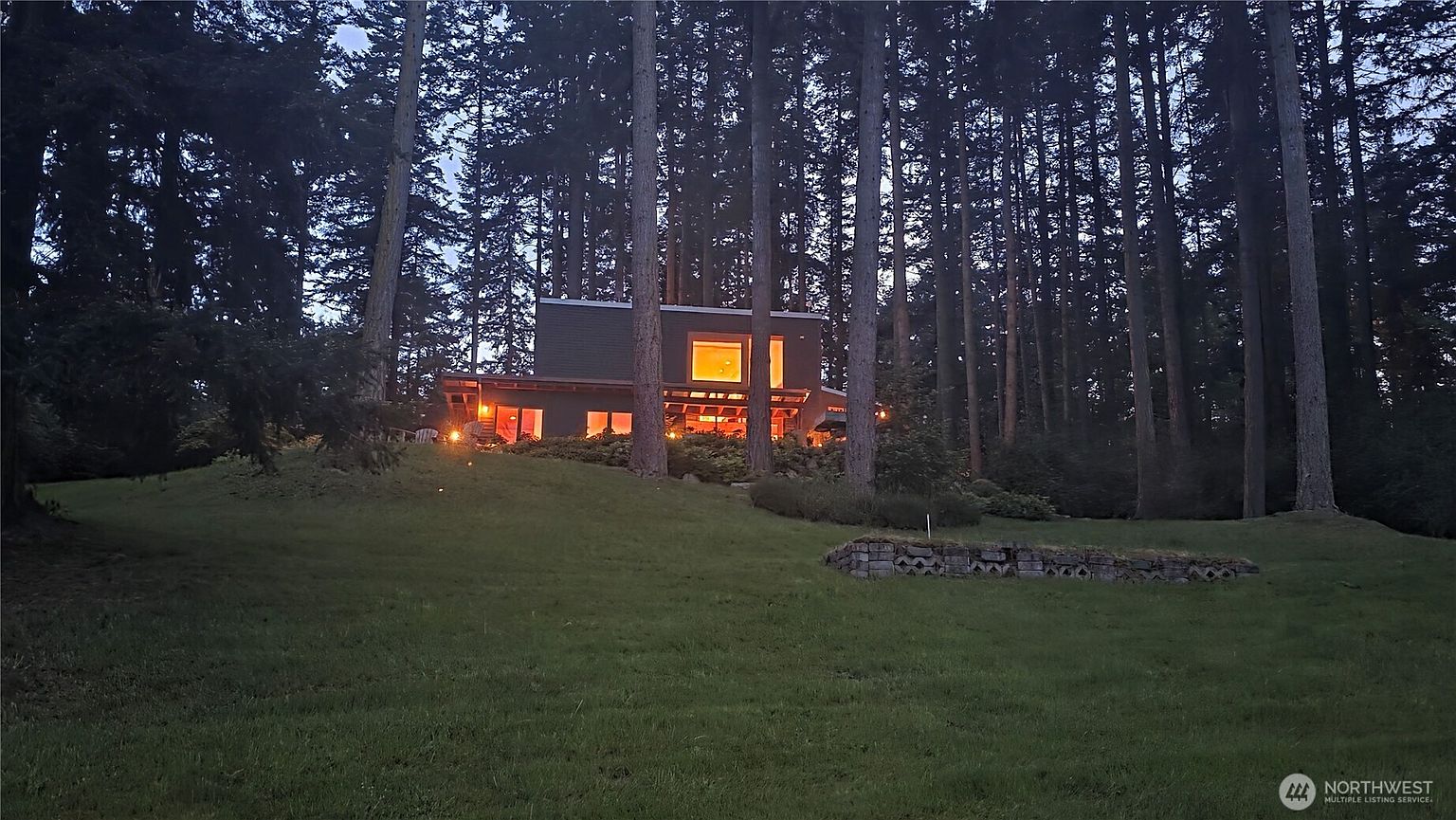
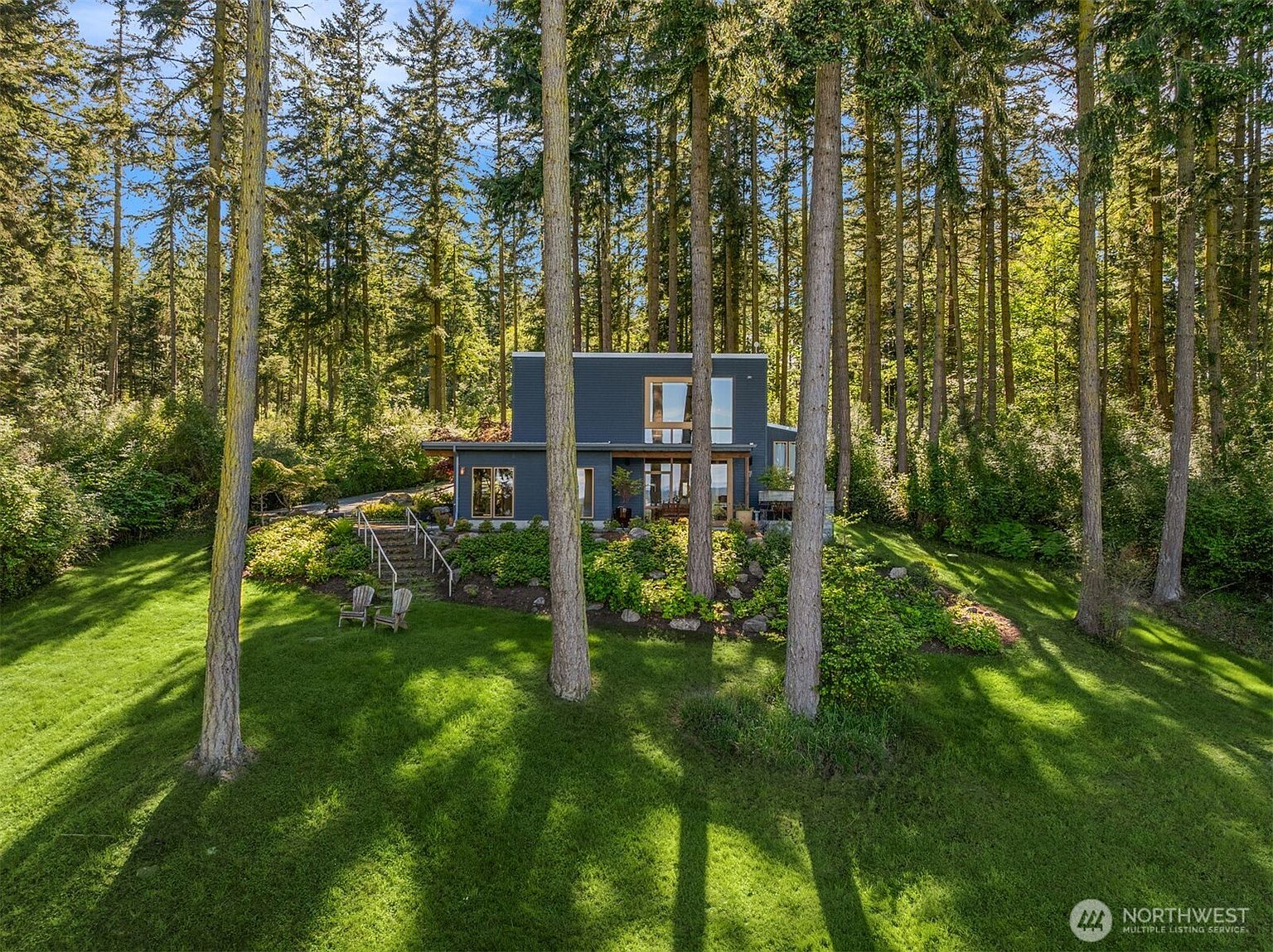
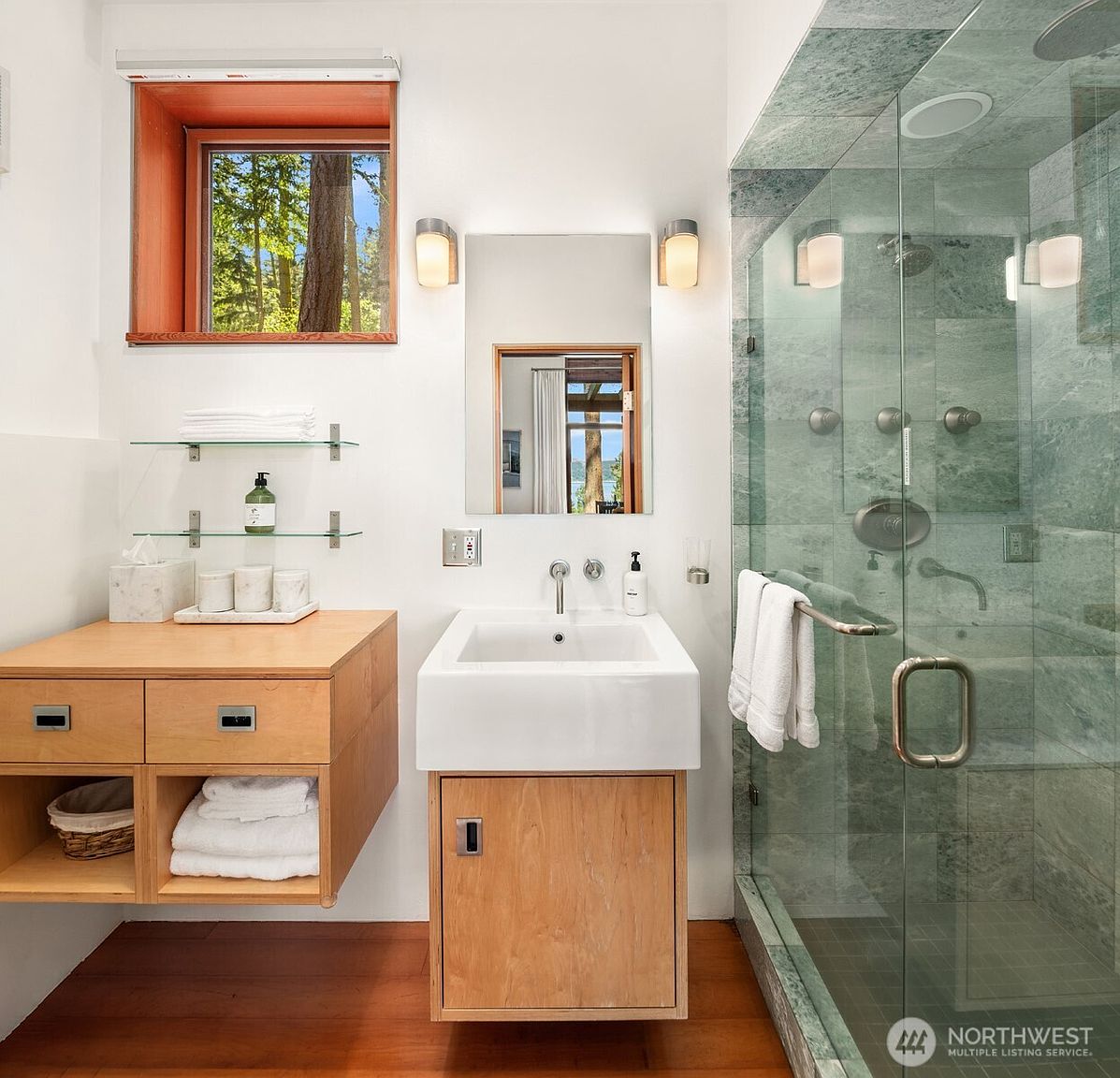
The second residence — known simply as the Dwell House and recognized by both Dwell Magazine and the Travel Channel — is a work of architectural conviction. Concrete, stainless steel, and natural wood converge with walls of glass in a composition that is at once boldly modern and deeply sympathetic to its wooded, waterfront context. It is a home that understands the land it occupies and responds to it on architectural terms, rather than imposing upon it. The result is a structure that feels inevitable — as though it could exist nowhere else.
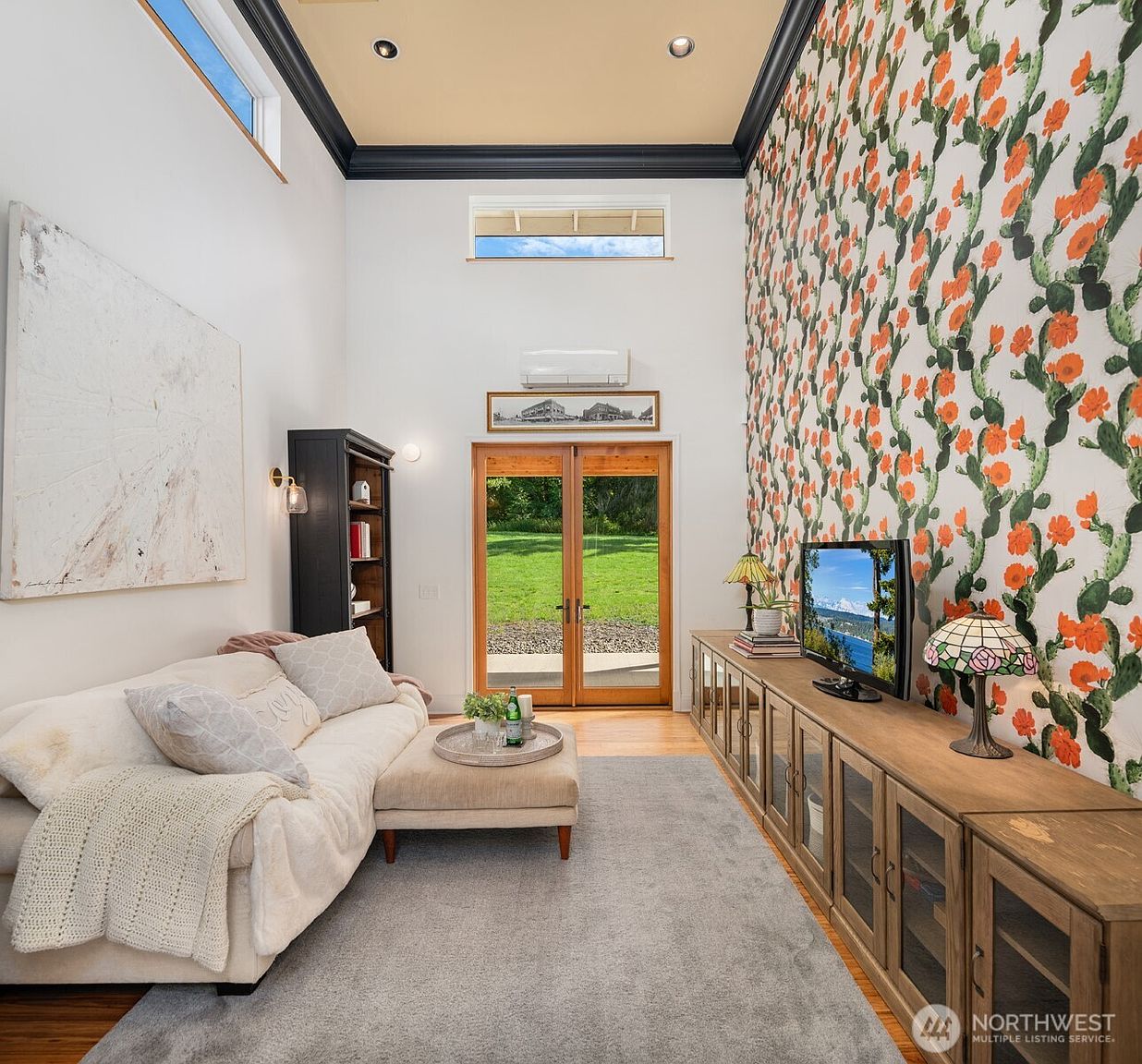
A separate 1,160-square-foot studio completes the compound's third chapter. Vaulted beamed ceilings soar above an open plan anchored by a loft and dramatic walls of glass that open directly to the orchard and the waterfront setting beyond. Whether conceived as a creative retreat, a guest suite, or an income-producing short-term rental — as it currently operates with success — the studio carries its own architectural weight.
Outdoors, the estate unfolds across twenty fully fenced acres with the generosity of a working countryside property: rolling pastures, a productive orchard, lavender fields that bloom in purple waves each summer, and a pebbled shoreline where Saratoga Passage laps quietly at the edge of the grounds. A concrete patio with a built-in stone fire feature and a wooden pergola extends toward the water, designed for the kind of evenings that linger. The second ten-acre parcel — fully buildable and separately taxed — holds its own considerable promise, whether for equestrian development, a guest compound, or the patient ambitions of a legacy estate builder.
Whidbey Island occupies a singular position in the Pacific Northwest imagination. At roughly sixty miles in length, it is one of the largest islands in the contiguous United States, connected to the mainland by the Mukilteo–Clinton ferry and to the Skagit Valley by the historic Deception Pass Bridge to the north — a span that has become one of the most photographed landmarks in Washington State. The island is not a place that was discovered recently; it has been shaped over decades by artists, farmers, naval families, and those who simply came for the water and never left.
Coupeville, the community nearest to this estate, is one of the oldest towns in Washington State, incorporated in 1910 and home to a historic waterfront district that remains remarkably intact. Central Whidbey Island, of which Coupeville serves as the county seat of Island County, is designated as a National Historic Reserve — the first of its kind in the United States — protecting not only individual structures but the broader agricultural and natural landscape that gives the area its character. The town's wharf, which dates to the late nineteenth century, extends over Penn Cove, whose waters are nationally recognized for producing some of the finest mussels cultivated anywhere on the West Coast.
Saratoga Passage, along which this estate sits, is the eastern channel separating Whidbey Island from Camano Island. Its deep, protected waters are a recognized thoroughfare for commercial and recreational vessel traffic, and the passage is renowned among boating communities throughout Puget Sound for its navigability and scenic drama. The channel is also a documented habitat corridor for orca and humpback whales, whose seasonal appearances along this stretch of shoreline are among the defining experiences of life on the island's eastern shore. Bald eagles nest throughout the surrounding forest canopy — a constant, unhurried presence above the property.
The broader Whidbey Island lifestyle is defined by a tension between remoteness and accessibility that many find to be precisely the point. The island supports a robust arts community, anchored in part by Coupeville's historic downtown galleries, the Whidbey Island Center for the Arts, and the Greenbank Farm — a former winery property now managed as a public gathering space and community hub. Farm stands, lavender farms open to the public each summer, and a network of hiking and equestrian trails through Ebey's Landing National Historical Reserve offer a depth of recreational and cultural engagement that belies the island's rural character.
Seattle lies approximately an hour and a half away via ferry and highway — close enough for regular engagement with the city's international airport, world-class dining, and cultural institutions, yet sufficiently distant to make the return crossing feel like a genuine departure from urban life. For buyers seeking a private compound of architectural significance in one of the Pacific Northwest's most storied and protected natural landscapes, the convergence of Coupeville's history, Saratoga Passage's drama, and Whidbey Island's enduring character offers something that cannot be manufactured elsewhere.
Featured Highlights
Curated Content • Presented by Kimberley "ALEX" Thomas