The Story Behind
RARE HALF-ACRE PARCEL WITH PLANS, VIEWS, AND MOMENTS TO DOWNTOWN ASPEN
There are properties that ask you to begin from nothing, and then there are those that offer you a running start toward something extraordinary. The lot at 1050 Cemetery Lane belongs firmly in the latter category. Here, on a generous half-acre parcel bathed in Colorado high-altitude sunlight, the most demanding and often most daunting phase of building in Aspen — the conceptual and approval process — has already been navigated on your behalf.
Architectural plans have been thoughtfully developed for a Modern Alpine residence that speaks fluently to both its mountain environment and the refined sensibilities of a discerning owner. The exterior language is one of honest materials in sophisticated dialogue: light-toned stone masonry grounds the structure with a geological permanence, while warm wood siding introduces an organic warmth that mirrors the surrounding grove of slender aspen trees and towering evergreen pines. A prominent stone chimney breast anchors the facade, and a covered pergola extends over the arrival experience, signaling from the first moment that this is a home designed with intention at every scale.
The site's forested perimeter is not incidental — it is architectural. A heavily landscaped buffer of native trees will effectively seclude the residence from Cemetery Lane, creating an arrival sequence that transitions from the public world to a private one with quiet drama. Once through, the home opens expansively toward the mountains.
Inside, the open-concept living and dining area rises beneath a soaring wood-beamed ceiling, a structural gesture that simultaneously references Aspen's mountain vernacular and elevates the space into something genuinely grand. Walls of tall windows pull the mountain panorama — Hunter Creek Valley, Aspen Mountain, Highlands — directly into the room, dissolving the boundary between interior warmth and exterior wilderness. A tall, light-colored fireplace surround anchors the central gathering space with quiet authority, flanked by a built-in bookshelf that adds intellectual texture to the room's considered materiality. A staircase connects to the upper level with the same clean architectural precision that defines the whole.
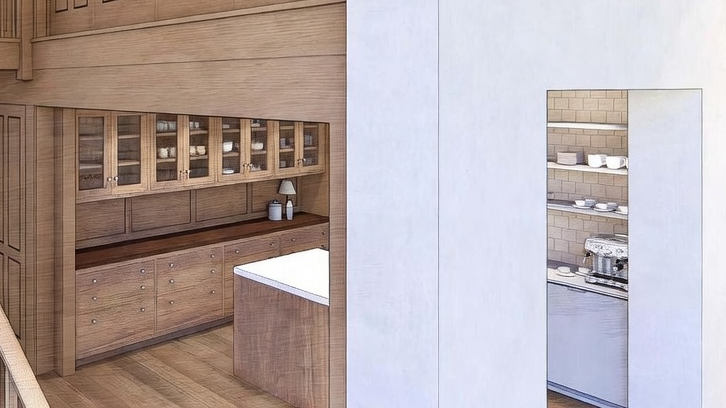
The kitchen is centered on a large island with bar seating, open shelving, and integrated appliances — a workspace designed for both the serious cook and the effortless host. A built-in bar extends the home's entertaining capacity with understated elegance.
The primary suite is conceived as a sanctuary. Large windows frame snow-covered peaks in a composition that changes with every season and every hour of light. Its en-suite bathroom offers a freestanding soaking tub positioned beneath a window that turns bathing into an act of communion with the landscape — a detail that reveals the true ambition of this design.
An elevated wooden deck with clean metal railing and a covered pergola extend the living space outward into the trees, completing a home that never asks you to choose between comfort and nature. At 1050 Cemetery Lane, the two are inseparable.
Cemetery Lane is one of Aspen's most storied residential addresses — a tree-lined corridor that has quietly housed some of the valley's most distinguished properties for decades. Its name, drawn from the historic Aspen Grove Cemetery at its western end, belies the extraordinary vitality of the neighborhood it anchors. Flanked by the Rio Grande Trail on one side and the wooded rise toward Hunter Creek on the other, this stretch of Aspen represents a rare convergence: genuine seclusion within walking distance of one of the world's most celebrated mountain towns.
Aspen itself needs little introduction, yet its character rewards closer examination. Founded as a silver mining camp in the late 1870s and incorporated in 1881, the city experienced a remarkable cultural renaissance in the mid-twentieth century when industrialist and civic visionary Walter Paepcke and his wife Elizabeth arrived with the ambition of transforming it into a center for intellectual and artistic life. The Aspen Institute, which they founded in 1949, remains one of the most respected nonpartisan think tanks and leadership forums in the world, attracting heads of state, Nobel laureates, and global innovators to its Meadows campus — just minutes from Cemetery Lane. The Aspen Music Festival and School, established in 1949 as part of the same cultural awakening, draws world-class musicians and audiences every summer, filling the Benedict Music Tent with performances that rival any concert hall on earth.
The skiing, of course, is legendary. Aspen Mountain — known locally as Ajax — rises directly above the town's Victorian-era core and is accessible via the Silver Queen Gondola from the base of Dean Street. Aspen Highlands, visible from the lot at 1050 Cemetery Lane, is celebrated for its challenging terrain and the iconic Highland Bowl, widely regarded as one of the finest in-bounds ski experiences in North America. Snowmass and Buttermilk complete a four-mountain complex that together offer more than 5,500 acres of skiable terrain.
Yet Aspen's appeal extends well beyond winter. The Rio Grande Trail — accessible in steps from this property — is a premier multi-use path that follows the historic Denver and Rio Grande Western Railroad grade through the Roaring Fork Valley, connecting Aspen to Woody Creek, Basalt, and ultimately Glenwood Springs over more than forty miles of scenic corridor. In summer and fall, it becomes the artery of the valley's outdoor life: cyclists, runners, and walkers moving through corridors of golden aspen and cottonwood beneath a sky of impossible blue.
Downtown Aspen, reachable in minutes, offers a dining and retail landscape that consistently surprises with its sophistication. From James Beard-recognized restaurants to flagship galleries representing internationally acclaimed artists, the commercial core of this small city punches well above its population of roughly seven thousand permanent residents.
To live on Cemetery Lane is to inhabit Aspen at its most authentic — connected to its cultural richness, its recreational abundance, and its natural grandeur, yet insulated from its bustle by a canopy of trees that has been growing here for generations.
Featured Highlights
Curated Content • Presented by Carol Hood Peterson