The Story Behind
A Pacific Heights Classic Poised for Its Next Great Chapter
There is a particular kind of home that reveals itself slowly — one that earns its admiration not through spectacle alone, but through the accumulating weight of its details. Built in 1951 on a generous 60-by-67.5-foot lot, 2240 Lyon Street is precisely that kind of property. Its facade announces itself with quiet authority: light-toned horizontal siding, a pair of symmetrical bay windows, and a red double door framed by a crisp arched white molding that speaks to the classical sensibility woven throughout the home's DNA.
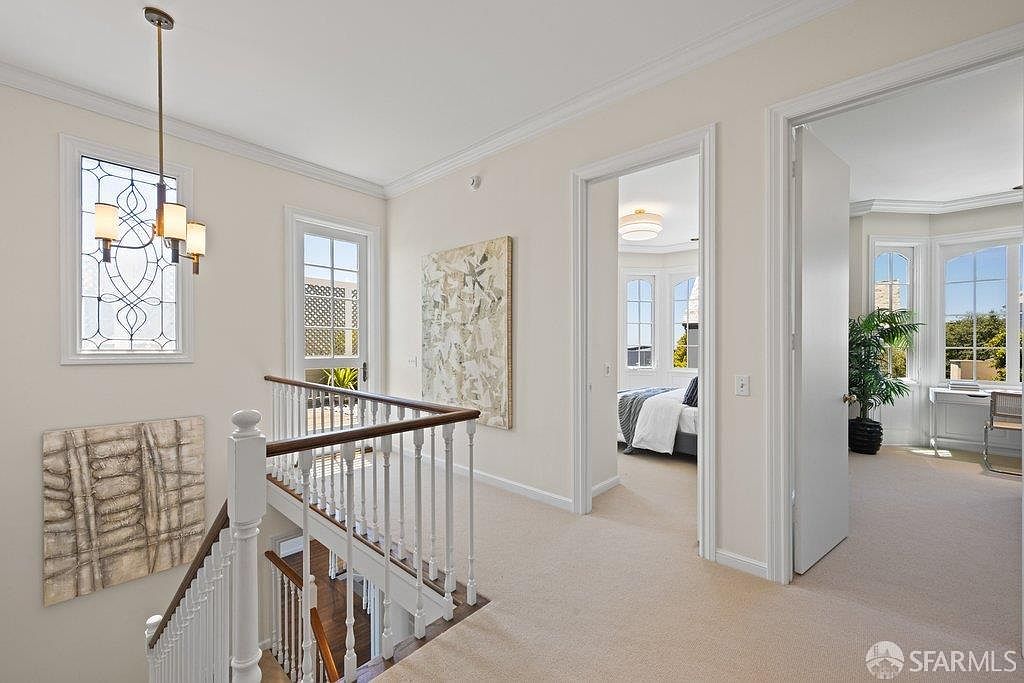
Step inside and the foyer sets the tone immediately. A sweeping curved staircase with a dark wood handrail and white balusters rises from a parquet floor, establishing an elegance that is residential rather than performative. The scale is generous without being intimidating, and natural light moves through the space with an ease that belies the home's age — a testament to the thoughtful interventions made over the decades.
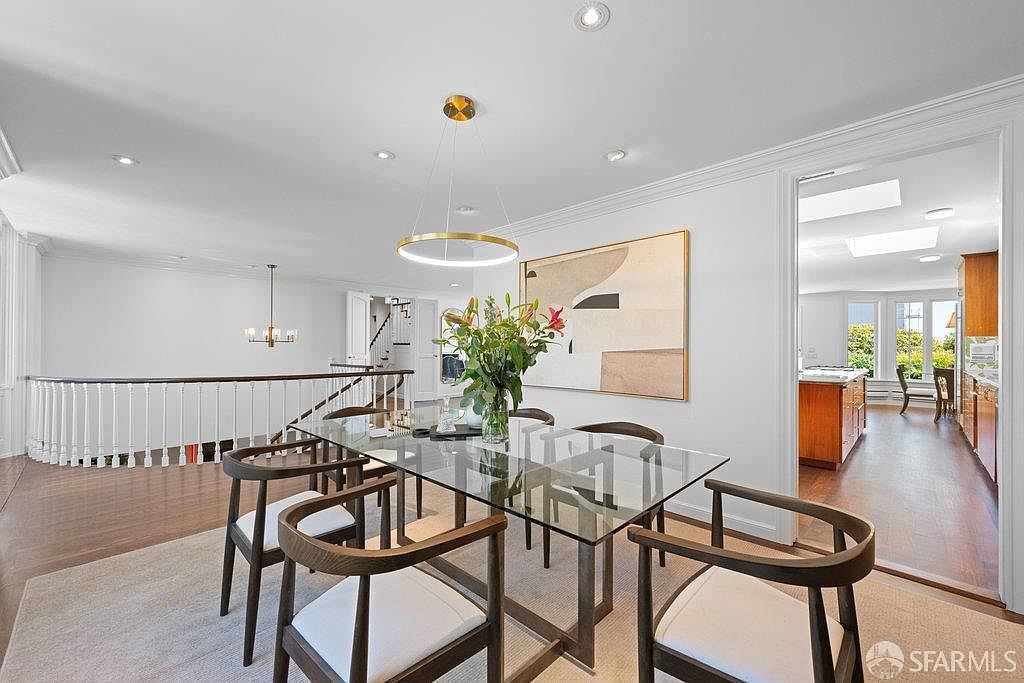
The kitchen occupies its own distinct world within the home. Warm-toned wood cabinetry wraps the perimeter, anchoring a large central island finished in stone. Above, a series of skylights draws daylight deep into the room, illuminating a distinctive floral-patterned tile backsplash that manages to feel both vintage and utterly current. The kitchen opens fluidly into the dining area, where a multi-pane bay window frames a tableau of the city skyline — a view that transforms an ordinary meal into something quietly extraordinary.
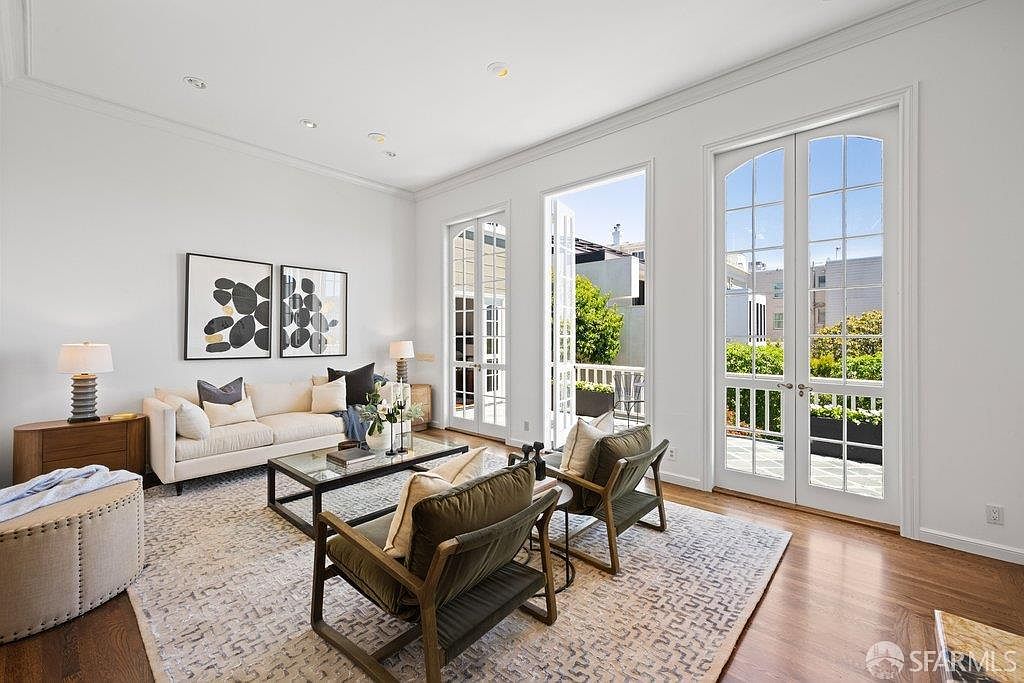
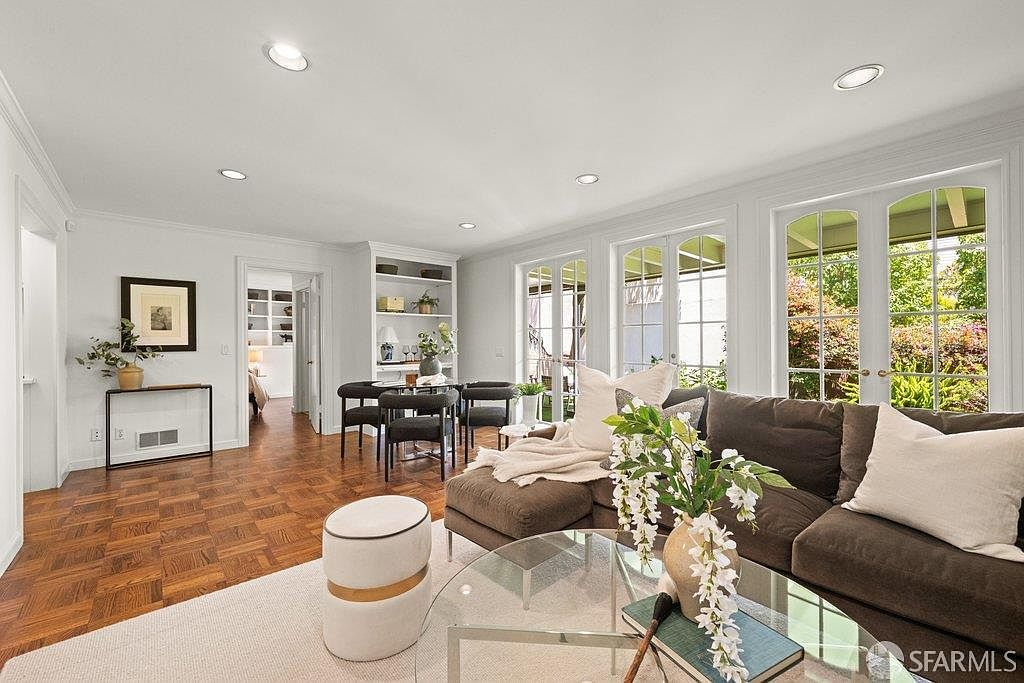
The main living area is anchored by a fireplace with a white brick surround, flanked by built-in shelving and a pair of tall French doors that give onto a private balcony. A second living space on a lower level echoes this arrangement — parquet flooring, a white brick fireplace, recessed lighting, and glass doors opening to the rear yard — giving the home a sense of layered domesticity that rewards every level of daily life.
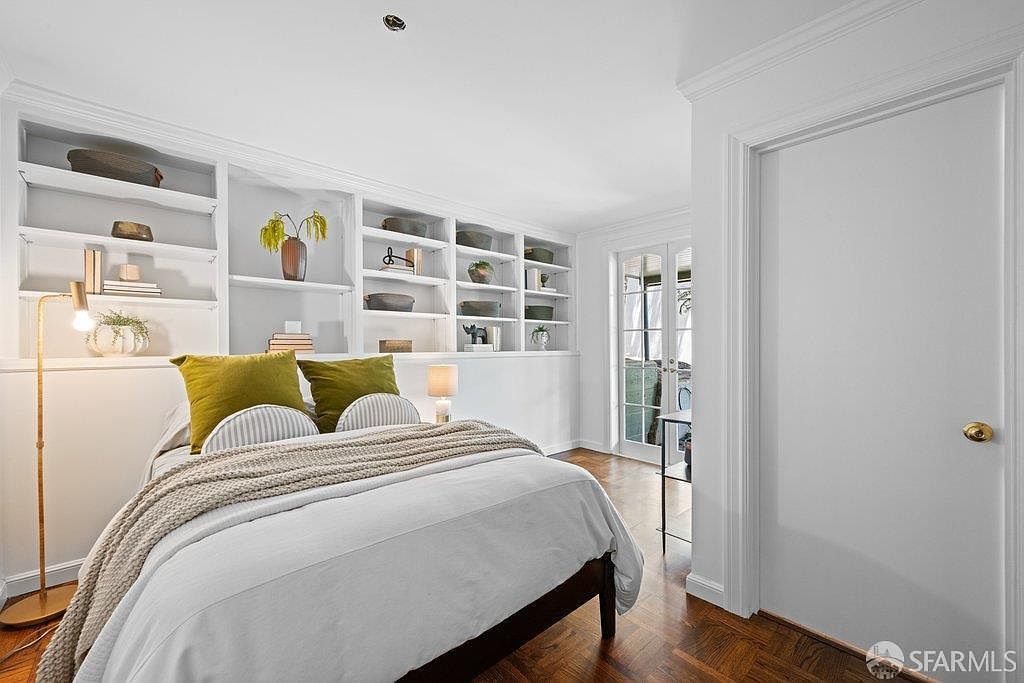
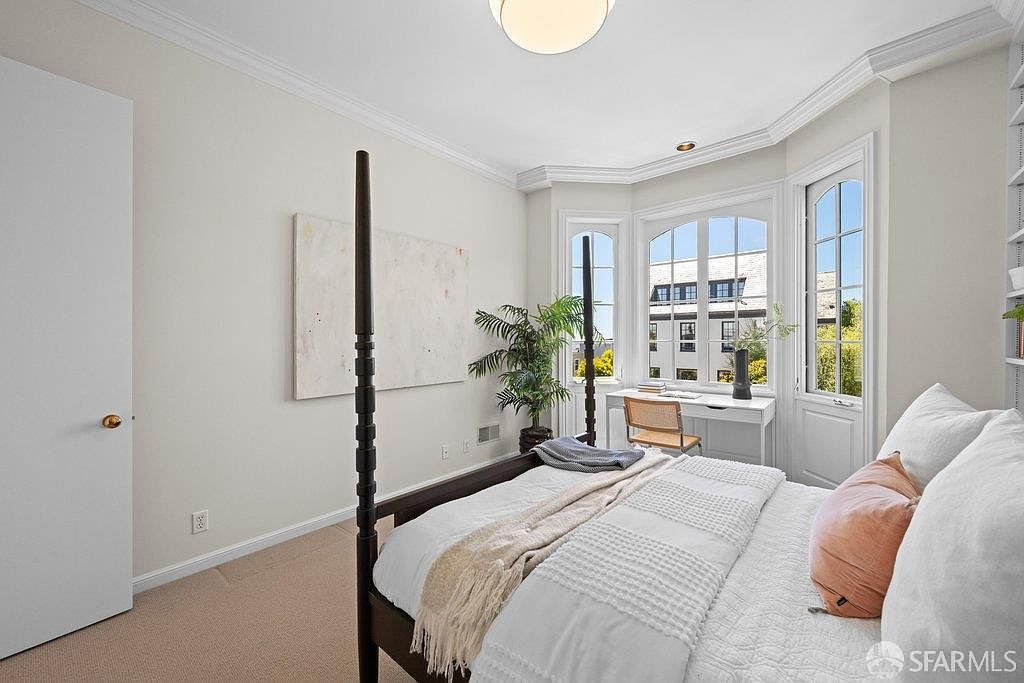
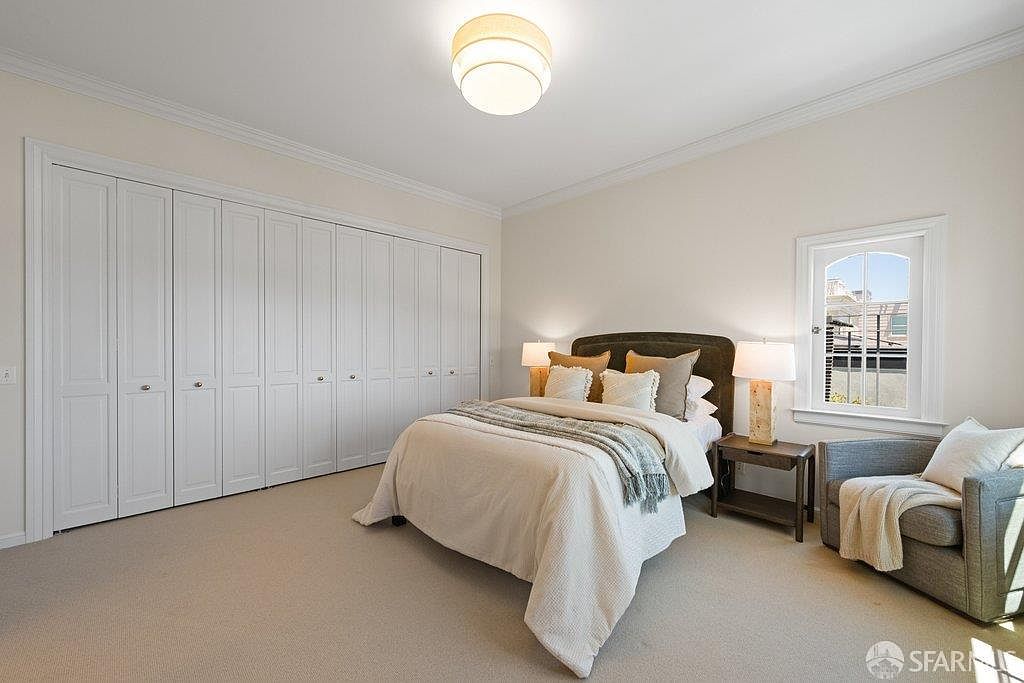
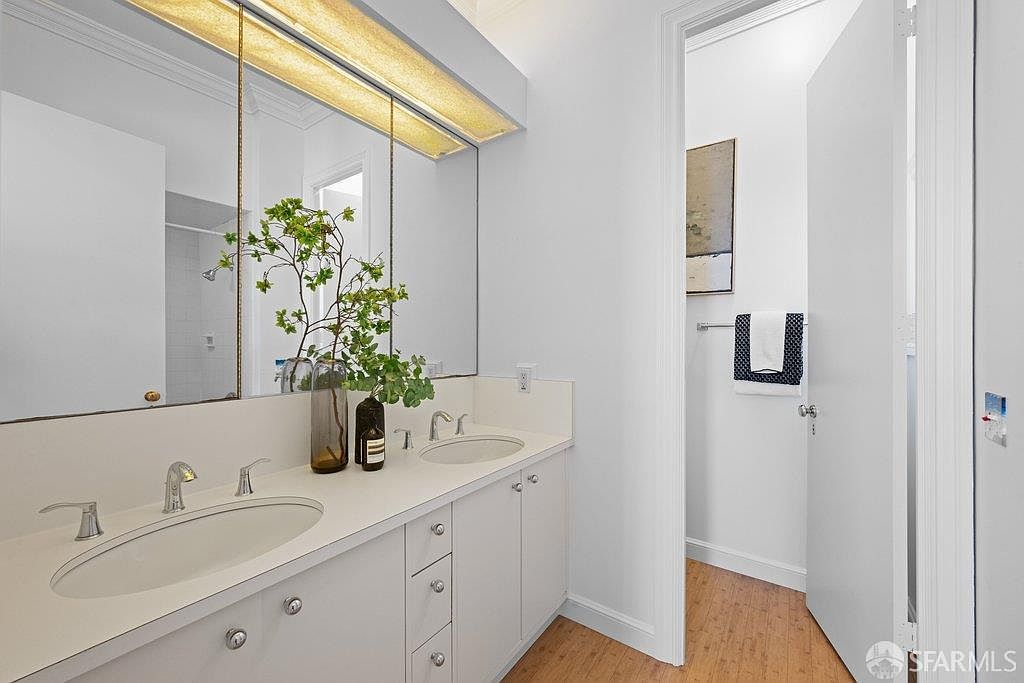
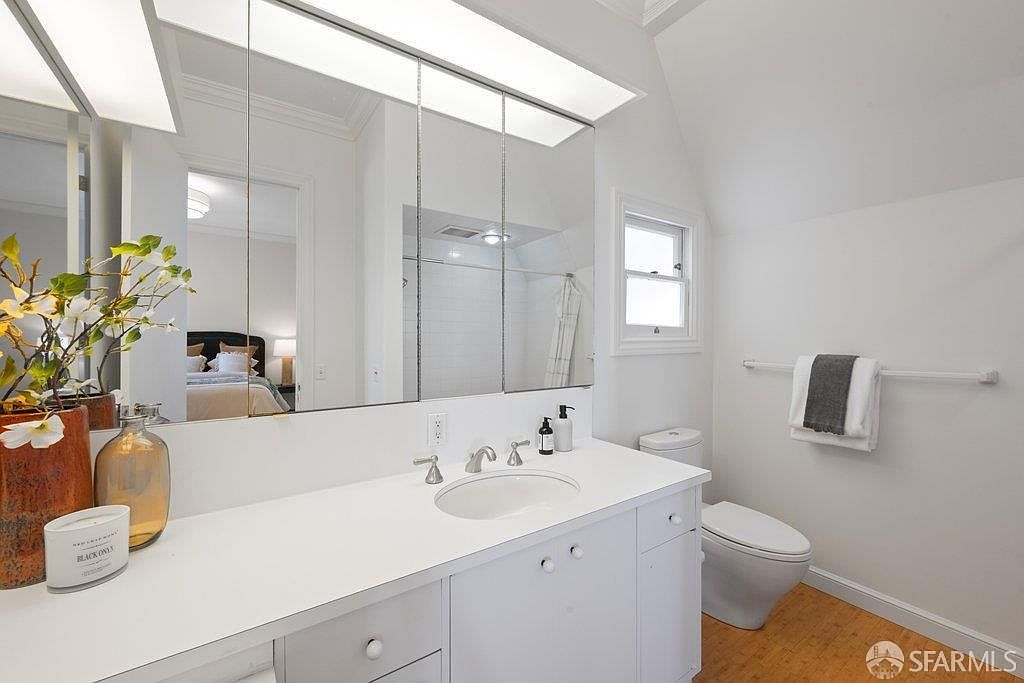
The primary suite is among the home's most compelling achievements. French doors open to a private outdoor terrace where the Salesforce Tower anchors a sweeping city panorama. Inside, a glass-enclosed shower, dual-sink vanity, and warm wood flooring compose a bathroom that feels genuinely spa-like without resorting to ostentation. Additional bedrooms are generous and well-proportioned, each with thoughtful storage and natural light.
Rooftop decking extends the home's living vocabulary skyward, offering an entertainer's perch above the treetops. Below, a manicured artificial turf yard bordered by mature landscaping creates a private garden retreat accessible from the ground-floor French doors.
Perhaps most compellingly, Sutro Architects has already produced June 2026 plans that would expand this 4,123-square-foot residence to 6,513 square feet with six or more bedrooms — a blueprint that transforms this exceptional existing home into something even more extraordinary, should the next steward choose to pursue it.
Pacific Heights occupies a singular position in the geography of San Francisco — literally and figuratively. Stretching along one of the city's highest ridgelines between approximately Octavia Street and Presidio Avenue, it has long been regarded as the city's most prestigious residential district, home to consular residences, landmark Victorians and Edwardians, and generations of San Francisco's civic and cultural leadership. The views from its elevated streets — south toward the downtown skyline, north across the bay toward Marin — are among the most celebrated in any American city.
Lyon Street itself is one of the neighborhood's most distinguished addresses. The block on which 2240 sits sits atop the ridge, placing it within easy reach of both the Presidio's 1,500 acres of national parkland and the boutique retail and dining corridor along Fillmore Street, which serves as Pacific Heights' de facto main street. Fillmore's stretch between California and Jackson streets is anchored by an eclectic mix of acclaimed restaurants, independent boutiques, wine bars, and specialty food purveyors that collectively define a distinctly San Francisco mode of urban village living.
The Presidio, accessible within minutes on foot or by bicycle, offers a remarkable counterpoint to city life — old-growth forests, coastal bluffs, Civil War-era military architecture, and miles of trails that terminate at Baker Beach and the foot of the Golden Gate Bridge. The Presidio Trust has developed the former Army post into one of the nation's most dynamic urban national parks, with cultural institutions, restaurants, and the Lucas Museum of Narrative Art currently under development nearby.
Families are well served by the neighborhood's proximity to a number of San Francisco's most respected independent and public schools, and the California Pacific Medical Center campus on Sacramento Street provides world-class medical resources within the immediate neighborhood. Alta Plaza Park, just a few blocks away, offers a terraced hilltop green space that is a beloved gathering point for the neighborhood — with tennis courts, a playground, and panoramic views in every direction.
The broader Pacific Heights community retains a residential character that is rare for a city of San Francisco's density and dynamism. Tree-lined streets, an active neighborhood association, and a strong tradition of architectural stewardship have preserved the area's scale and character across generations. Many of the city's most significant cultural institutions — the San Francisco Symphony, the San Francisco Museum of Modern Art, the de Young Museum in Golden Gate Park — are all within a reasonable distance, making Pacific Heights a natural home for those who want proximity to the city's cultural life without sacrificing neighborhood tranquility.
At 2240 Lyon Street, the rooftop deck places the Salesforce Tower and the full downtown skyline on the horizon, a daily reminder of the city that surrounds and sustains this remarkable neighborhood. It is a location that offers everything San Francisco promises — culture, nature, community, and beauty — in precisely the measure that makes a house feel like home.
Featured Highlights
Curated Content • Presented by Ted Bartlett