The Story Behind
A Classical Landmark Estate on a Rare Old Highland Park Acre
There are homes that are built, and there are homes that are authored. This estate at 3711 Lexington Avenue belongs unmistakably to the latter category. Conceived as the final full house commission of Cole Smith — the revered Classicist behind Smith-Ekblad & Associates whose body of work has shaped the architectural identity of Dallas's most storied neighborhoods — the residence stands as both a personal and professional capstone, a distillation of everything a life devoted to classical architecture can produce.
The exterior announces itself with quiet authority. Stone masonry, dark timber framing, and a steep multi-pitched roofline compose a Tudor-inflected silhouette that feels simultaneously rooted in tradition and entirely its own. A central arched entry, flanked by decorative statuary and framed by diamond-patterned arched windows, draws visitors toward a threshold that signals the world within. This is a home that understands ceremony.
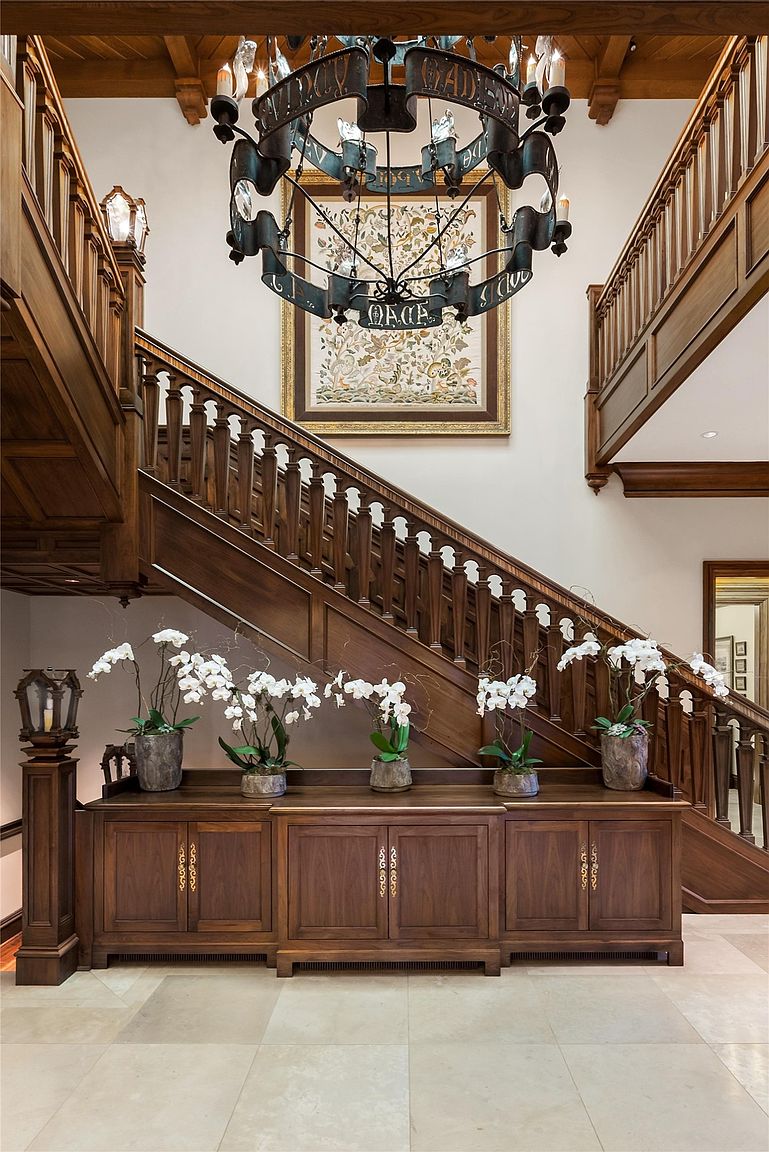
Passing through the grand double doors, the foyer opens beneath a soaring chandelier, its light falling across stone floors and rich wood trim as a sweeping wooden staircase — detailed with intricate lattice-style railings — ascends toward the upper levels. The architecture does not rush. It unfolds deliberately, each room earning its place in a carefully considered sequence of spaces.
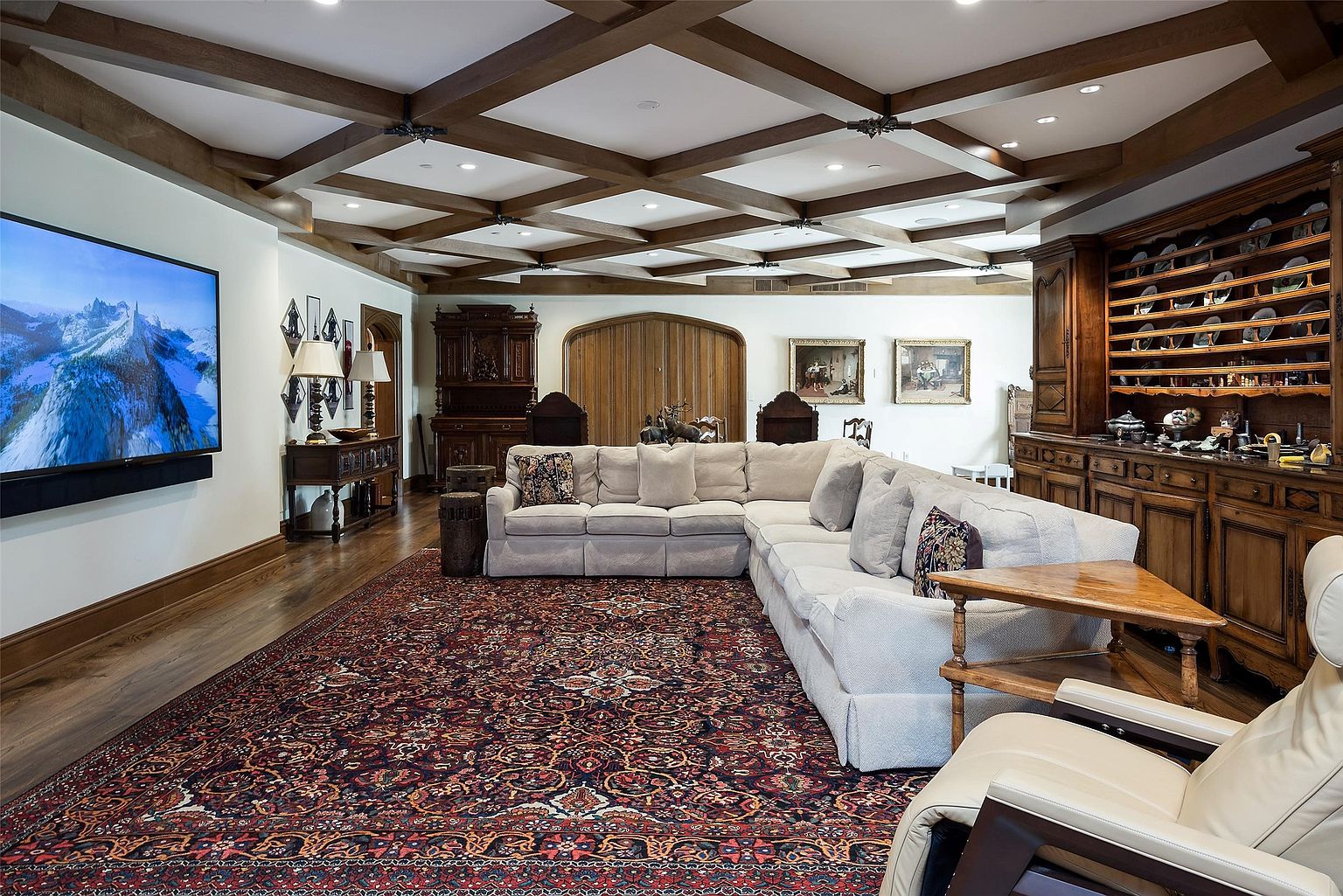
The two-story Great Room is the estate's emotional center. Vaulted timber-beamed ceilings rise above wood-paneled walls, and the room has been engineered with masterful acoustics — a detail that elevates an already remarkable space into something approaching the rarefied. Multiple seating arrangements anchor the room's generous proportions, while wide openings connect seamlessly to a screened porch complete with its own fireplace, extending the living experience into the surrounding landscape.
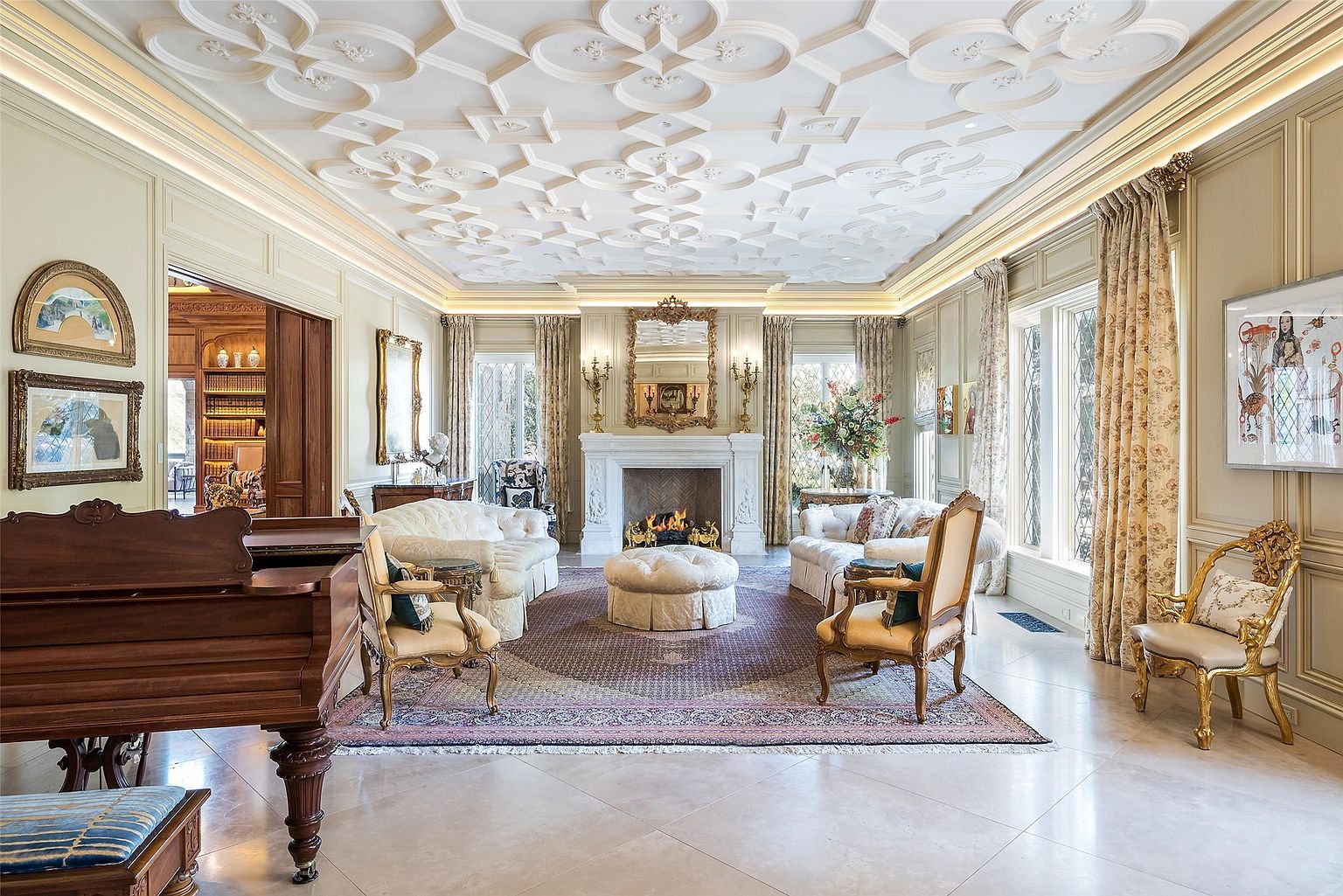
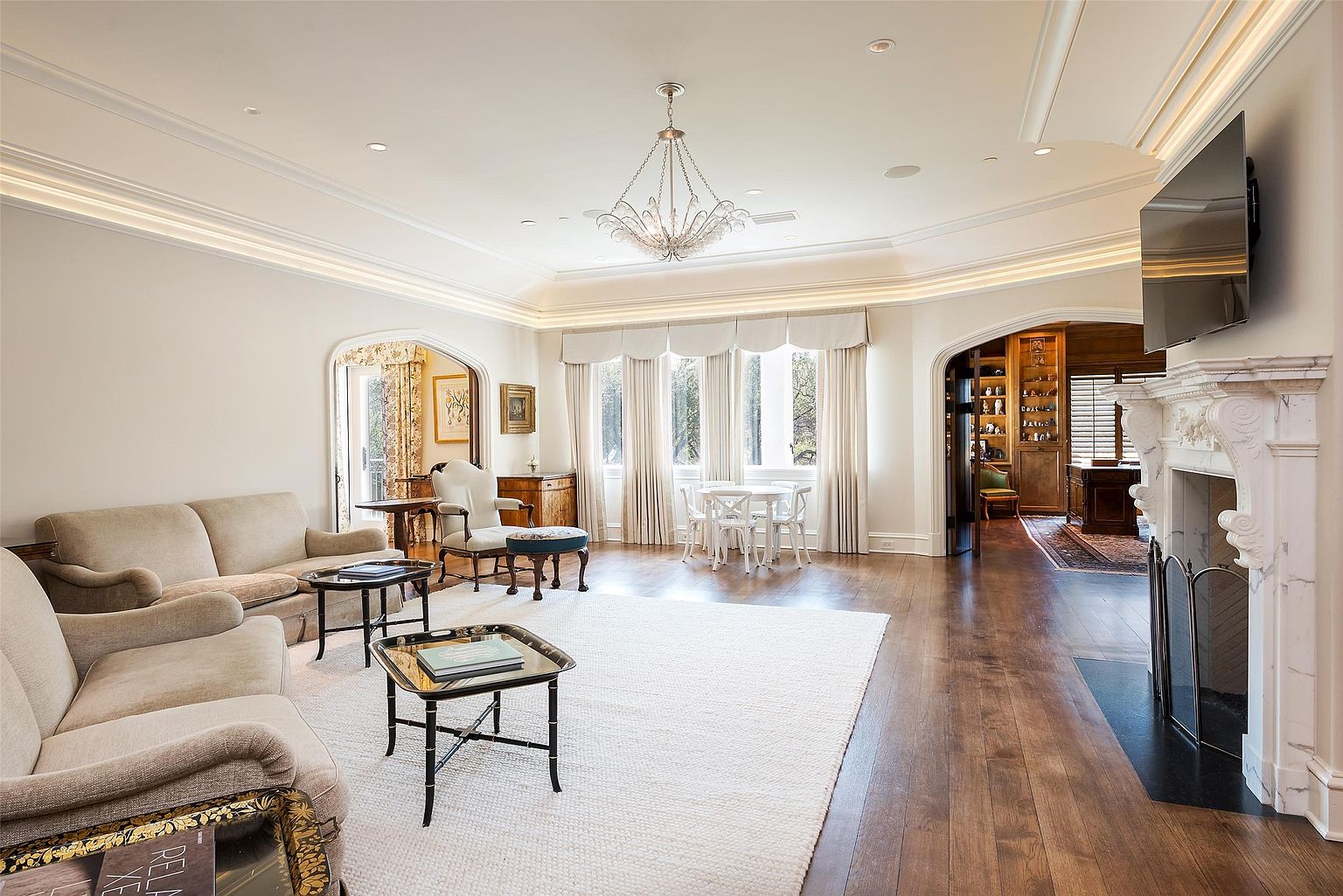
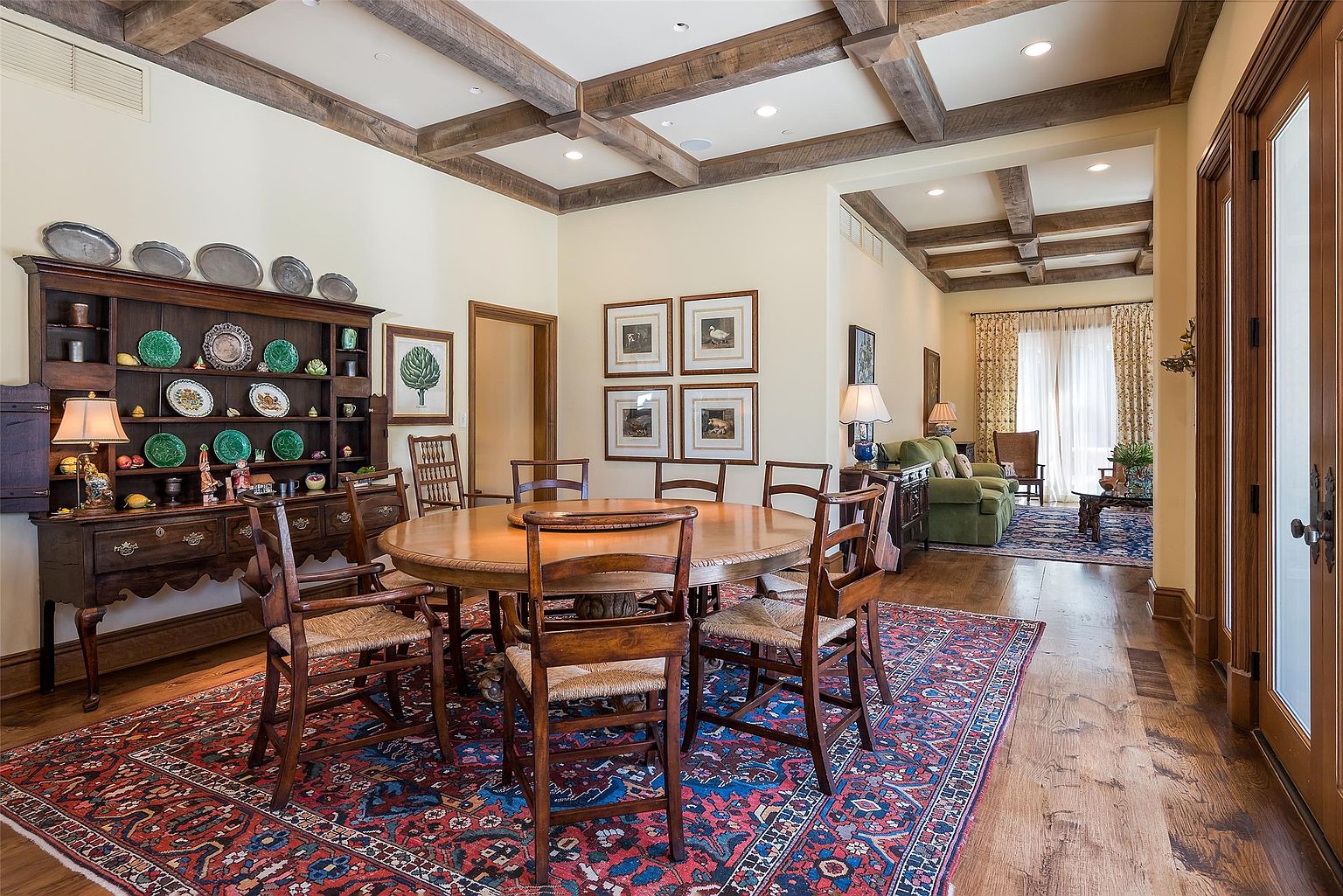
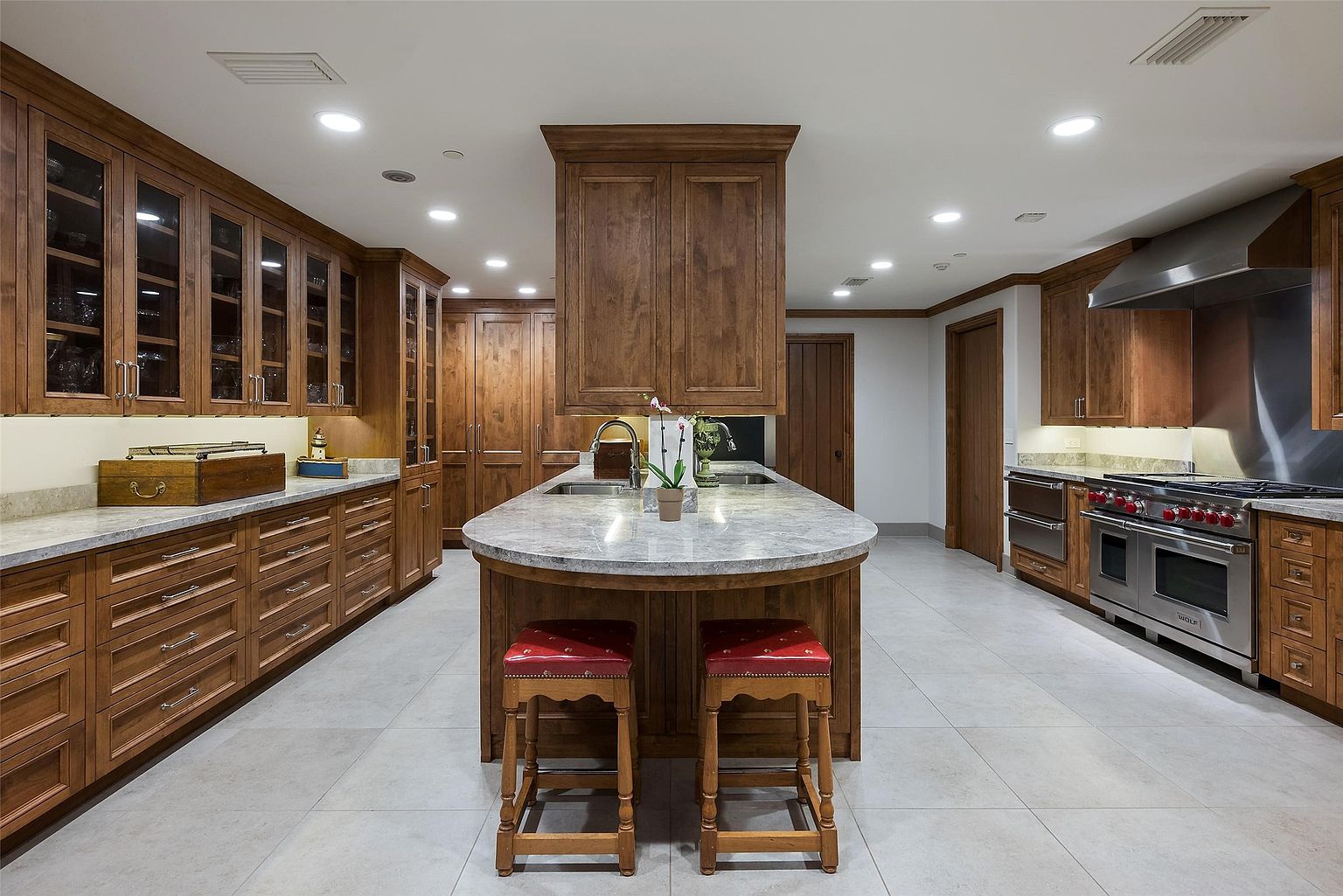
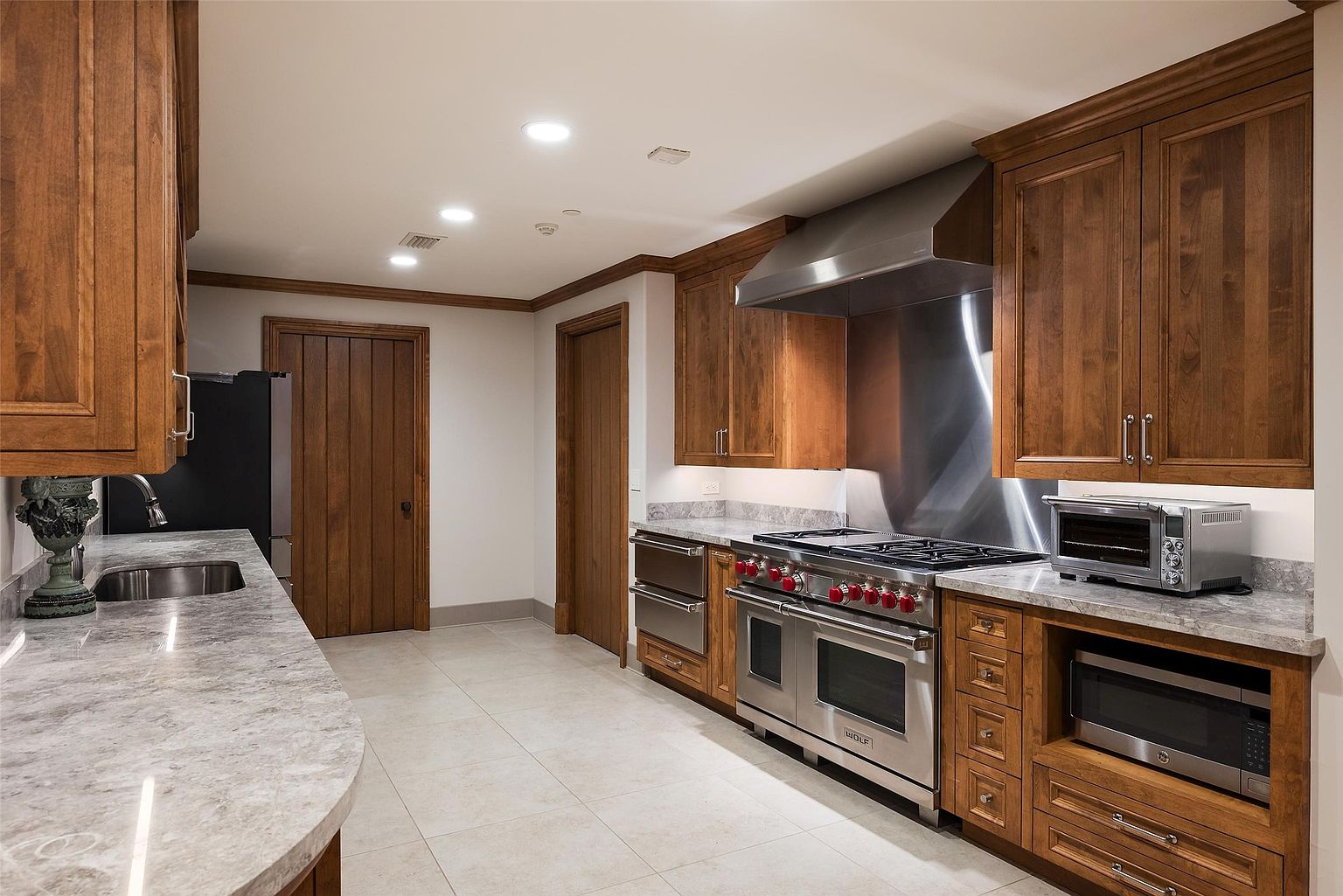
The kitchen presents a study in professional-grade elegance: dual islands surfaced in stone, dark wood cabinetry, exposed ceiling beams, and a commanding range beneath a prominent hood — a workspace that serves equally as a gathering place. Adjacent formal dining and living rooms are distinguished by ornate coffered ceilings, crystal chandeliers, and views across manicured grounds and mature trees.
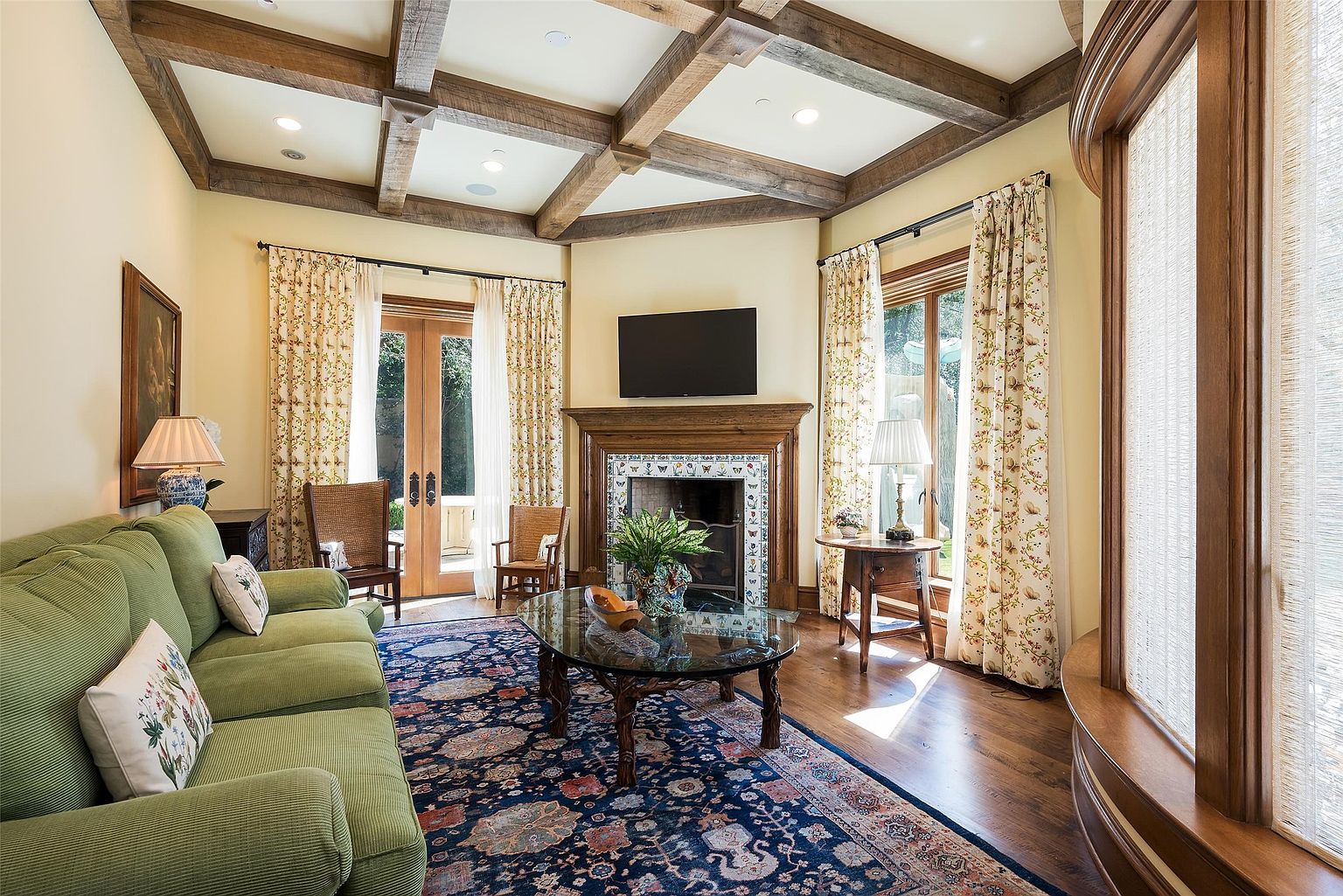
The wood-paneled study, lined with built-in shelving and anchored by a stone fireplace surround, reflects the intellectual ambition woven throughout the home. A dedicated natatorium houses an oversized pool with integrated spa, enclosed beneath a vaulted ceiling and a wall of windows that floods the space with natural light. Seven fireplaces punctuate the four floors, each one distinct in character and surround.
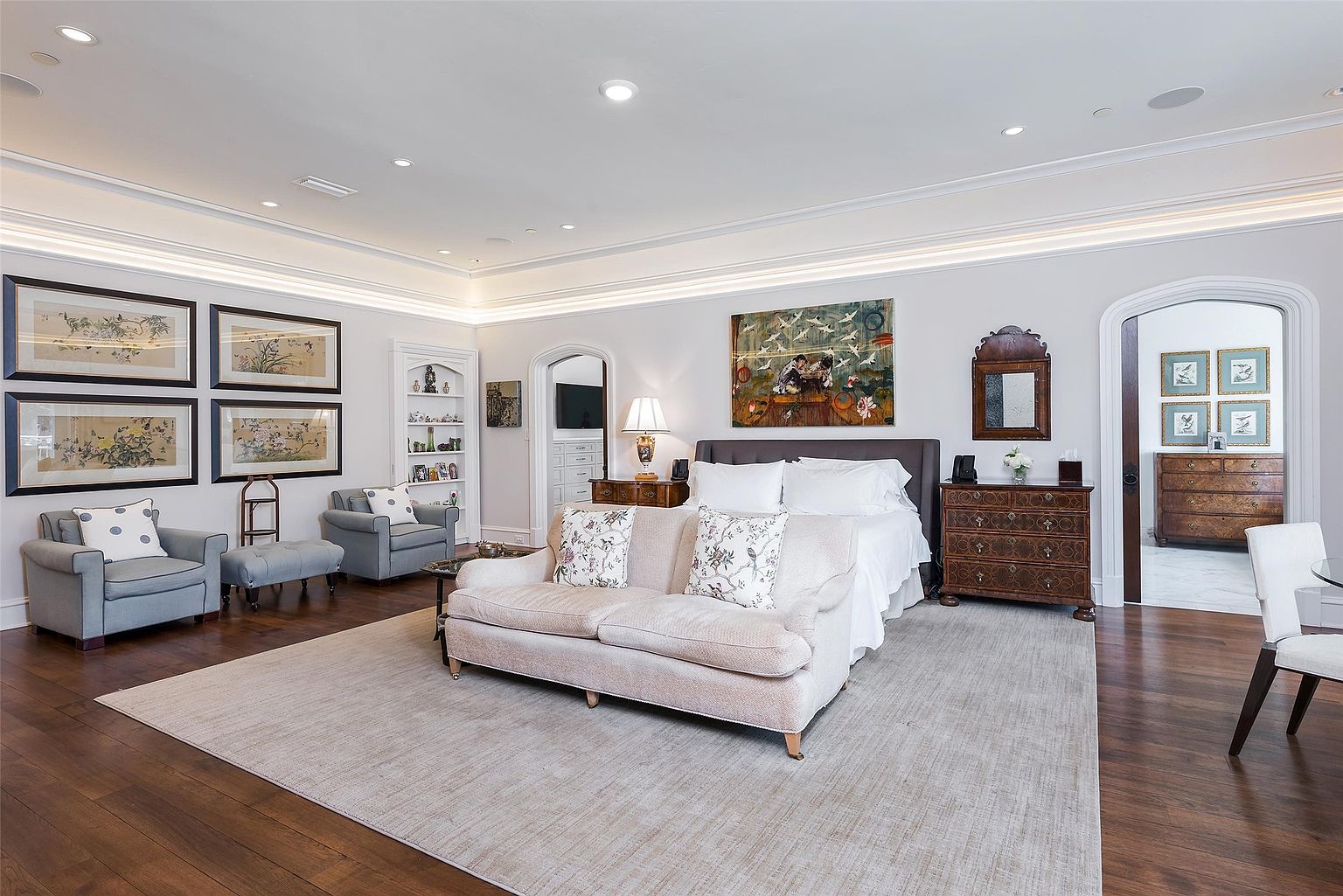
The primary suite is an exercise in considered restraint: dark hardwood floors, a tray ceiling, and a bath of sweeping proportions featuring dual vanities, stone countertops, a crystal chandelier, and a deep soaking tub set within a bay window — a composition of calm that feels more like a private sanctuary than a room in a house.
A submerged garage preserves the full expanse of the rear acre for outdoor living, while a commercial elevator serves all four floors with ease. Interiors by Sherry Hayslip layer warmth and depth across every surface, ensuring that no detail — however small — was left to chance. This is a home built without compromise, finished without apology, and offered without equal.
Old Highland Park occupies a place in the Dallas imagination that few neighborhoods in any American city can claim. Established in the early twentieth century as one of the nation's first planned residential communities, it was developed beginning around 1906 by the Flippen-Prather Realty Company, which engaged noted Kansas City landscape architect George Kessler — the same visionary behind the broader Dallas park and boulevard system — to shape its streets, parks, and green corridors. The result was a neighborhood conceived from its inception around the principles of beauty, permanence, and civic order.
Highland Park is an incorporated town entirely surrounded by the city of Dallas, and it has long maintained its own municipal services, including its own police and fire departments, as well as the highly regarded Highland Park Independent School District — consistently ranked among the top public school systems in the state of Texas and the nation. The schools serve as both a practical draw and a reflection of the community's enduring commitment to excellence.
The physical character of Old Highland Park is defined by its canopy of mature trees, its generous lots, its winding park-adjacent streets, and the remarkable diversity of its architecture — Tudor, Georgian, Mediterranean, and Classical Revival homes coexist in a streetscape that rewards close attention. Properties of the scale and distinction found at 3711 Lexington Avenue are exceedingly rare; full-acre lots along the greenbelt corridor represent some of the most coveted real estate in North Texas.
Dallas Country Club, one of the most prestigious private clubs in the American South, is situated within the neighborhood and serves as a social anchor for the community. The club's golf course, designed in the early twentieth century, weaves through the landscape in a manner that enhances the verdant, park-like character of the surrounding streets. Membership in the club has long been a cornerstone of Highland Park social life.
Mockingbird Lane and Preston Road serve as the neighborhood's primary commercial corridors, placing residents within minutes of Highland Park Village — widely recognized as the first planned shopping center in the United States, opened in 1931 and now home to flagship boutiques from Hermès, Chanel, Tory Burch, and a curated collection of independently owned shops and restaurants. The Village functions not merely as a retail destination but as a genuine community gathering place, with events and programming woven throughout the calendar year.
Cultural life in the broader Dallas area is rich and accessible. The Dallas Museum of Art, the Nasher Sculpture Center, the Perot Museum of Nature and Science, and the Morton H. Meyerson Symphony Center are all within easy reach, as are the galleries and programming of the Dallas Arts District — one of the largest contiguous urban arts districts in the United States.
For an estate of this architectural significance, the setting at 3711 Lexington Avenue is not incidental — it is essential. The greenbelt and creek that border the property are not simply amenities; they are the natural extension of a neighborhood built on the belief that where one lives should be, in every sense, extraordinary.
Featured Highlights
Curated Content • Presented by Ralph Randall